

For many outdoor whirlpool hot tub owners, one of the most frustrating moments isn't a broken heater or a malfunctioning jet; it’s lifting the cover one day to find a strange, yellow, slimy substance in what used to be crystal-clear water. It might float along the water's edge, cling to the pleats of the filter, or—like mucus—stick to the jets, the inner shell walls, or the waterline. Even worse, once this yellow sludge appears, simply scooping it out rarely solves the problem.
Many users find that even after changing the water, adding chlorine, and cleaning the filter cartridge, the water quality struggles to return to a truly clear state; within days, it may turn yellow or cloudy again and start foaming.
This is actually a severely underestimated issue in the outdoor whirlpool hot tub industry. During sales, many brands focus heavily on promoting jet counts, massage intensity, LED mood lighting, and Bluetooth audio, yet rarely explain to users that water quality management is a core factor determining the long-term spa hot tub experience. To cut costs, some budget products compromise on circulation systems, filtration surface area, plumbing layouts, and even the material of the pipe interiors. This makes the equipment more prone to circulation "dead zones," biofilm buildup, and microbial contamination after just a year of use. While the user sees yellow slime on the surface, the underlying issue is often an imbalance in the spa hot tub's internal micro-ecosystem.
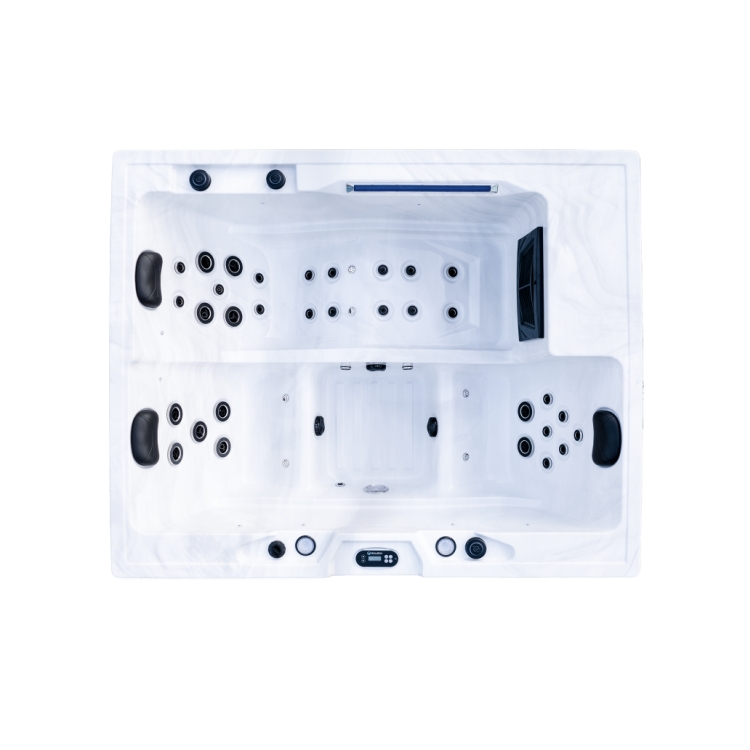
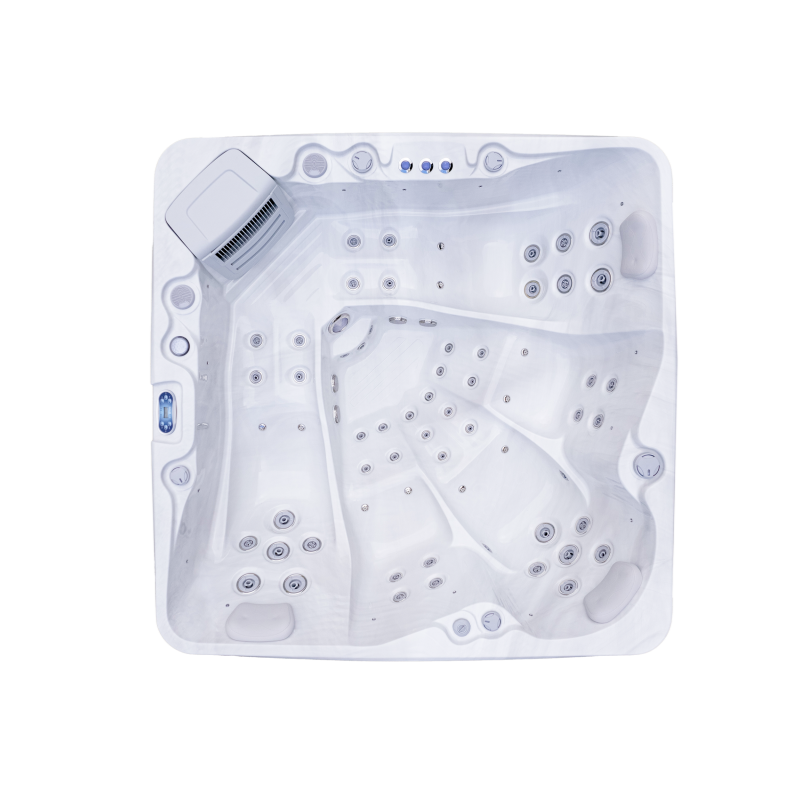
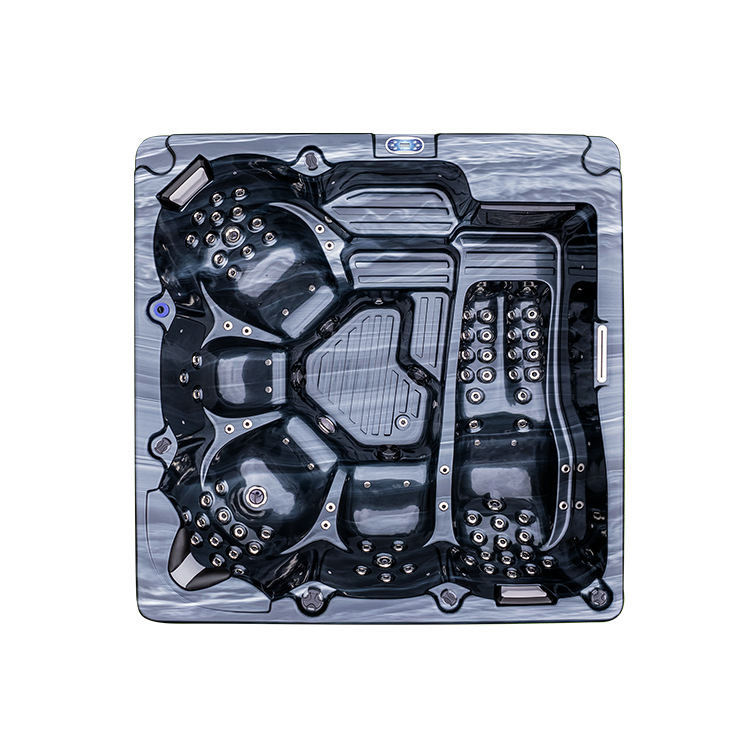
In contrast, established manufacturers are increasingly prioritizing the fundamental principle that "structural design dictates maintenance difficulty." Take LOVIA®, for example: during the R&D process, alongside the hydrotherapy experience, they focus on optimizing circulation flow rates, filtration coverage, and plumbing layouts to minimize water flow dead zones and areas where organic matter accumulates.
Certain LOVIA® models feature multi-layer filtration structures, high-flow circulation systems, and optimized water return designs. The value of these configurations lies not merely in stronger water flow, but in maintaining a more stable water quality environment throughout the whirlpool hot tub. Industry experience has demonstrated that whether a hot tub develops a yellow, viscous substance over time depends largely on the equipment's own water management capabilities, rather than solely on the user's diligence in maintenance.
So, what exactly is this yellow, viscous substance? Why is it so persistent once it appears? And how can it be thoroughly eliminated? This article provides an in-depth analysis from three perspectives: microbiology, water chemistry, and equipment design.
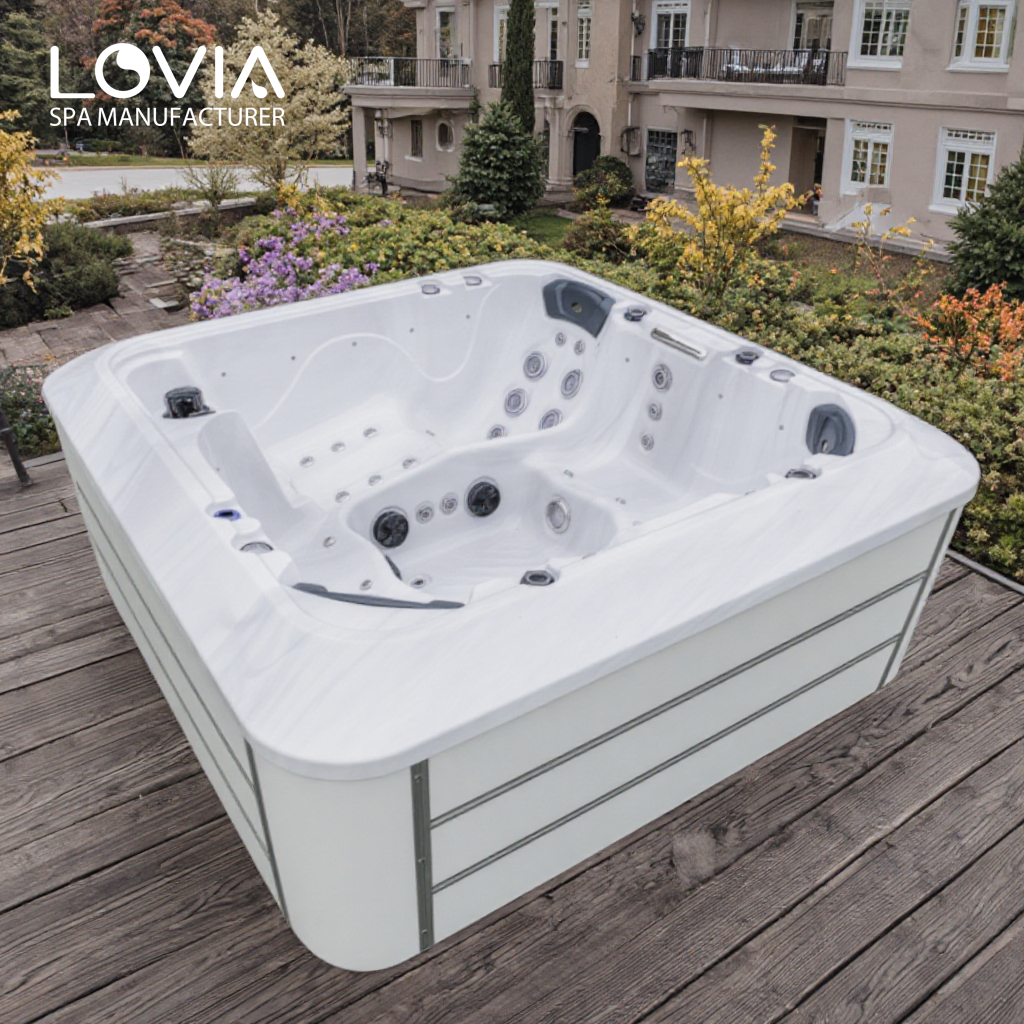
What exactly is the yellow, viscous substance found in outdoor spa hot tubs?
First, it is important to clarify that this yellow, viscous substance is not a single entity but a mixture of various components. Based on numerous maintenance cases involving outdoor whirlpool hot tubs, this type of yellow or yellowish-brown sludge typically originates from four sources: biofilms, bacterial polymers, deposits of oily organic matter, and mineral-based accumulations. Among these, biofilm is the most common and the most difficult to treat.
Biofilm is essentially a "protective community" established by a group of microorganisms. Once bacteria enter an outdoor whirlpool hot tub, they do not remain suspended in the water indefinitely; instead, they tend to adhere to surfaces such as the inner walls of plumbing, the areas behind jets, and the edges of filters. Upon attachment, the bacteria secrete extracellular polymeric substances (EPS), composed primarily of polysaccharides, proteins, and lipids. This substance feels very sticky to the touch and can appear transparent, milky white, yellow, or yellowish-brown.
Once formed, biofilm acts like a suit of bulletproof armor for the bacteria. Standard concentrations of chlorine struggle to penetrate the entire biofilm structure to kill the bacteria within. Research indicates that bacteria protected by biofilm can be 100 to 1,000 times more resistant to disinfectants than bacteria in a free-floating state. This explains why many hot tub owners encounter unpleasant odors, cloudy water, and yellow sludge even when chlorine levels test within the normal range.
The second common source is contaminants introduced by the human body. Every time a user enters the whirlpool hot tub, they introduce significant amounts of organic matter, including sweat, sebum, skincare products, cosmetic residues, sunscreen, and hair care products. Research data shows that a single adult can release a dissolved contaminant load equivalent to 0.5 to 1 liter of sweat during a 30-minute soak. When these organic substances combine with the high-temperature water environment, they gradually form sticky deposits. A third source involves the deposition of minerals and metal ions. If the water source has high hardness or elevated levels of iron and manganese, these minerals can combine with organic contaminants to form a yellow, gelatinous substance. This phenomenon is particularly pronounced under high-pH conditions.
A fourth source consists of algal or fungal residues; while less common in high-temperature outdoor whirlpool hot tubs than in swimming pools, they can still appear in conditions with insufficient chlorine and abundant sunlight.
Why is this yellow, viscous substance so difficult to remove once it appears in an outdoor spa hot tub?
This is precisely what baffles many whirlpool hot tub owners. People often ask, "I’ve already changed the water, so why does it come back?" The answer usually lies not in the water itself, but within the plumbing.
The key difference between an outdoor whirlpool hot tub and a standard bathtub is the presence of a complex internal circulation system. Extensive piping connects the jets, pumps, heaters, and filtration systems. The interiors of these pipes are not perfectly smooth, nor is the flow constant and rapid. In reality, once the equipment stops running, areas of low flow—or even stagnant water—develop; these spots become prime "settlement zones" for microorganisms.
The problem becomes complicated when the core component of this yellow sludge is biofilm, as biofilm possesses three distinct characteristics:
First, it adheres extremely strongly. Simply changing the water cannot remove contaminants attached to the pipe walls.
Second, it has the capacity to cause re-contamination. Even if you completely replace the water in the whirlpool hot tub, any residual biofilm in the pipes will contaminate the fresh water.
Third, it continuously releases particles. As the biofilm ages, it sloughs off to form suspended particles, repeatedly clouding the water.
This is why the appearance of yellow sludge often traps users in a vicious cycle: adding chlorine → water clears briefly → sludge reappears → adding more chemicals → the problem recurs.
Why does this yellow sludge make it increasingly difficult to keep the spa hot tub water clear?
The fundamental reason is that it alters the chemical balance of the entire body of water.
For one, the yellow sludge continuously consumes sanitizer. Whether it is biofilm, organic oils, or bacterial polymers, these substances deplete free chlorine rapidly. Under normal circumstances, the recommended free chlorine level for an outdoor whirlpool hot tub is 1–3 ppm. However, if significant amounts of this yellow, viscous substance are present, the rate of chlorine consumption can increase to two to five times the normal level.
Secondly, this viscous substance increases the water's Total Organic Carbon (TOC) level. Elevated TOC indicates a higher "pollution load," which directly leads to:
•Cloudy water
•Increased foaming
•Stronger odors
•Increased formation of chloramines
Thirdly, the yellow, viscous substance can clog the filter. The filter is crucial for maintaining water clarity in an outdoor whirlpool hot tub; however, when the filter cartridge becomes coated with this sticky substance, water flow efficiency drops significantly. As filtration efficiency declines, more particles remain in the water, causing it to become increasingly cloudy.
Fourthly, it creates a vicious cycle regarding the water's micro-ecosystem. More bacteria lead to more secretions; more secretions create a thicker protective layer; and a thicker protective layer makes it harder for disinfectants to penetrate. Consequently, contamination levels grow exponentially.
How can you thoroughly remove this yellow, viscous substance from your outdoor whirlpool hot tub?
Many users' first reaction is to add chlorine, but this is usually insufficient.
A truly effective solution typically involves a four-step process.
Step 1: Deep Plumbing Clean
If the yellow, viscous substance has already appeared, simply changing the water is of limited value. You must use a specialized plumbing cleaner to clean the entire circulation system.
Run the jet system for 15 to 30 minutes to ensure the cleaner circulates through all the pipes.
This is a critical step for breaking down the biofilm.
Step 2: Shock Treatment
After cleaning the plumbing, perform a high-intensity shock treatment.
You can use:
•Chlorine shock
•Non-chlorine oxidizing shock
•Ozone-assisted disinfection
The goal is to completely oxidize residual organic matter.
In cases of severe contamination, raising free chlorine levels above 10 ppm for a short period is usually more effective.
Step 3: Thorough Filter Cleaning
This is a step many users overlook.
If the filter has already accumulated a large amount of the yellow, viscous substance, the cartridge will re-contaminate the entire spa hot tub, even if the main body of water has been cleaned.
It is recommended to:
•Perform a deep soak cleaning
or
•Replace the filter cartridge entirely
This is especially important for cartridges that have been in use for more than 12 months.
Step 4: Restore Water Chemistry Balance
After refilling the water, ensure the following levels:
•pH: 7.2–7.8
•Total Alkalinity: 80–120 ppm
•Chlorine: 1–3 ppm
This step determines whether the yellow, viscous substance recurs.
Why are high-quality outdoor whirlpool hot tubs less prone to this issue?
Many users assume the yellow, viscous substance is solely a maintenance issue, but equipment design plays a significant role.
High-quality outdoor whirlpool hot tubs typically feature:
Higher circulation efficiency.
Fewer water flow "dead zones."
Larger filtration surface area.
More optimized plumbing layouts.
More stable sanitization systems.
Take LOVIA® as an example: our outdoor spa hot tubs utilize optimized circulation plumbing, high-flow circulation pumps, and multi-layer filtration systems. For large-capacity outdoor whirlpool hot tubs, more uniform circulation ensures that sanitizers are distributed thoroughly to every area, thereby reducing the chance of microbial colonization. The value of such designs may not be immediately apparent at the time of purchase, but the difference becomes increasingly obvious after 1 to 3 years of use: lower maintenance frequency, greater water quality stability, and a lower probability of yellow, viscous substance formation.
How can you prevent the yellow, viscous substance from reappearing in your outdoor spa hot tub?
Prevention is more important than remediation.
We recommend establishing the following habits:
Test water quality 2–3 times a week.
Perform a shock treatment once a week.
Clean the filter cartridge every 2–4 weeks.
Change the water every 3–4 months.
Shower briefly before entering the water.
Minimize the introduction of skincare products into the water.
While these measures may seem basic, they can significantly reduce the likelihood of the yellow, viscous substance forming.
FAQ
Is the yellow, viscous substance in an outdoor spa hot tub necessarily bacteria?
Not necessarily. It could be a mixture of biofilm, oils, organic deposits, minerals, or various contaminants, though biofilm is the most common cause.
Why does the yellow, viscous substance return after changing the water in an outdoor spa hot tub?
Because the source of contamination is often hidden within the spa hot tub's internal plumbing, rather than in the water itself.
Can adding chlorine completely solve the problem of the yellow, viscous substance in an outdoor whirlpool hot tub?
Usually not. Simply adding chlorine often provides only a temporary fix; it must be combined with plumbing cleaning and filtration system maintenance.
Can the yellow, viscous substance in an outdoor whirlpool hot tub affect human health?
Yes. If the source is a biofilm or bacterial colony, it may increase the risk of skin irritation, rashes, or even infection.
What are the advantages of LOVIA® regarding water quality management?
Selected LOVIA® outdoor whirlpool hot tubs feature high-flow circulation systems, multi-layer filtration structures, and optimized plumbing designs. These elements help minimize stagnant zones and improve water turnover efficiency, thereby reducing the risk of contaminant accumulation at the equipment level.
