

Chlorine levels are always a crucial and unavoidable topic in the routine maintenance of swim spa tubs. Many users find that the chlorine level in their swim spa tub is below the recommended range when testing water quality, leading to a very real and critical question:
Is it still safe to swim in a swim spa tub with low chlorine levels?
This question seems simple, but it involves disinfection principles, water safety, human health, and the operating logic of the swim spa tub. Without a sufficient understanding, it's easy to overlook potential risks simply because the water appears clear.
This article will systematically analyze the role of chlorine in swim spa tubs from a professional perspective and clearly answer the question: Is it suitable to continue swimming in a swim spa tub with low chlorine levels?
Why is chlorine needed in swim spa tubs?
The core function of chlorine is not to make water "cleaner and more aesthetically pleasing," but rather to:
• Kill bacteria, viruses, and microorganisms in the water
• Inhibit the growth of algae and organic pollutants
• Prevent water quality from deteriorating rapidly
For swim spa tubs, due to the relatively high water temperature and concentrated usage frequency, this environment is more prone to microbial growth than a regular swimming pool, thus making them more reliant on disinfectants.
What is a "low chlorine" swim spa tub?
In professional water quality management, "low chlorine" is not a vague concept but has a defined range.
Generally, the effective residual chlorine in a swim spa tub needs to be maintained within a stable range to ensure continuous disinfection. When the chlorine content is below this range, it can be considered "low chlorine."
It's important to note:
• Low chlorine content ≠ water immediately becomes dirty
• Low chlorine content ≠ immediate odor or turbidity
However, low chlorine content means the disinfection barrier is weakening.
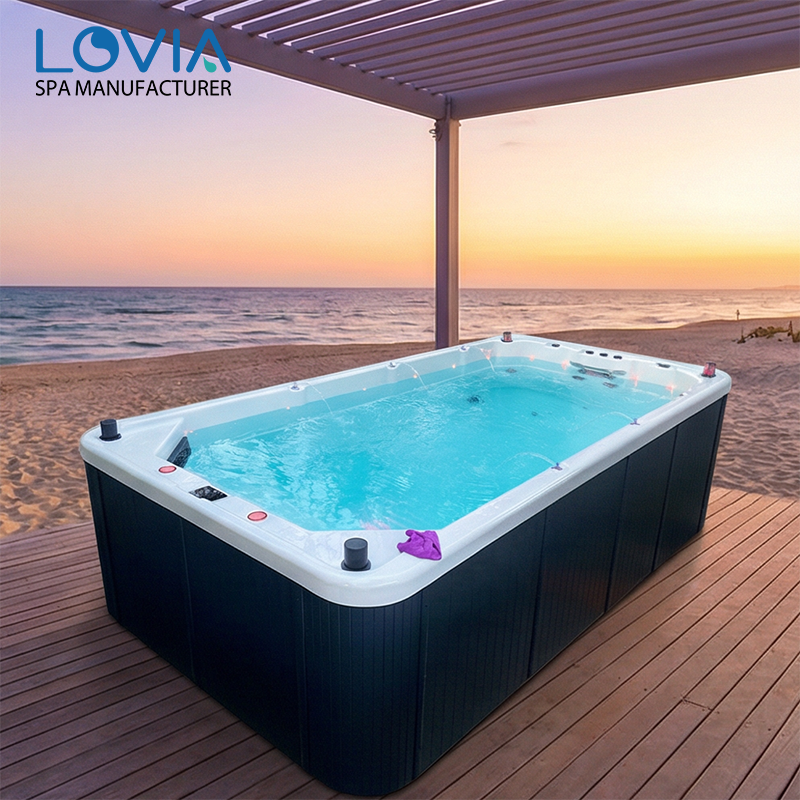
Is the water in a swim spa tub truly safe when the chlorine content is low?
When chlorine levels are low, the water in a swim spa tub may appear clear, odorless, and without any obvious abnormalities for a short period. However, from a professional perspective, safety has already begun to decline, mainly due to the following reasons:
• Bacteria multiply faster than they are killed.
• Organic matter (sweat, sebum, etc.) cannot be continuously decomposed.
• The number of microorganisms may accumulate rapidly in a short time.
In other words, the "appearance" of the water does not represent its "hygienic condition."
Can you swim for a short time in a swim spa tub with low chlorine levels?
From a strict water quality management perspective, swimming in a swim spa tub with chlorine levels below the safe range is not recommended, even for a short time, as there are potential risks. The reasons are:
• Swimming accelerates the entry of contaminants into the water.
• Human activity increases water temperature and disturbs the water.
• The spread of microorganisms is significantly accelerated.
Swimming in this condition is equivalent to prolonged contact with water in an environment with insufficient disinfection.
Why are swim spa tubs more susceptible to "low chlorine" than regular swimming pools?
Many people confuse swim spa tubs with traditional swimming pools, but their disinfection strategies differ significantly.
Swim spa tubs typically have the following characteristics:
• Relatively small water volume
• Higher water temperature
• Higher user density
• Faster water circulation
These characteristics mean that if chlorine levels are low, water quality deteriorates more rapidly. Therefore, swim spa tubs often have higher requirements for chlorine stability than regular swimming pools.
Does a low chlorine level necessarily mean an immediate ban on swim spa tub use?
From a professional management perspective, if test results show that the chlorine level is below the safe range, it should be considered unsuitable for swimming.
It's important to clarify that:
• This is a preventative assessment
• It's not about taking action only after a problem occurs
• The goal is to protect the health of users
Water quality management in swim spa tubs emphasizes "proactive control," not "remedial action."
What impact might low chlorine levels have on swim spa tub users?
While this article doesn't cover specific cases, the principle is clear: swimming in insufficiently disinfected water may pose the following risks:
• Prolonged skin contact with unclean water
• Contact with microorganisms in the eyes and ears
• Uncontrollable bacterial count in the water
These risks may not be immediately apparent, but from a health perspective, avoiding swimming in low-chlorine swim spa tubs is a safer choice.
Why can't you judge the safety of a swim spa tub solely by its smell?
Many users believe, "No chlorine smell means the water is milder and safer." This understanding is incorrect.
In reality:
• A noticeably pungent odor usually comes from chloramine, not available chlorine.
• Low chlorine levels may actually result in no noticeable odor.
• Odorless does not equal sterile.
Therefore, you cannot determine whether a swim spa tub is suitable for swimming based on smell.
Does low chlorine levels mean you should immediately add chlorine before swimming?
Logically, yes.
When a swim spa tub is found to have low chlorine levels, the correct course of action should be:
1. Stop swimming in it.
2. Restore the water's disinfection capacity.
3. Wait until the chlorine level returns to a safe range before using it again.
During this process, patiently waiting for the water quality to recover is more important than "forcing use."
What is the most easily overlooked risk of "low-chlorine water" in a swim spa tub?
The most easily overlooked point is that the low-chlorine state is often short-lived, but the accumulation of problems is insidious.
If the swim spa tub is repeatedly used in a low-chlorine state, pollutants and microorganisms in the water will continue to accumulate. Even with subsequent additions of disinfectant, it may take a longer time to restore water quality balance.
Are there "more human-friendly" low-chlorine swim spa tubs?
Many people worry about the irritation of chlorine to the skin and eyes, and therefore tend to deliberately reduce the chlorine content. From a professional perspective:
• The key is not "low chlorine," but "appropriate chlorine levels."
• Stable, appropriate chlorine levels are actually safer.
• Uncontrolled chlorine levels are the real source of risk.
Water quality management in swim spa tubs aims for balance, not simply reducing disinfectant levels.
How should we rationally view the question, "Can I swim in a swim spa tub with low chlorine levels?"
Considering water safety, disinfection principles, and the operational characteristics of swim spa tubs, a clear conclusion can be drawn: Swimming in swim spa tubs with low chlorine levels is not recommended.
This is not out of conservatism, but based on the following facts:
• Insufficient disinfection capacity
• Invisible water quality risks
• Swimming will amplify the problem.

Can you swim in a swim spa tub with low chlorine levels?
From a professional, rational, and safe perspective, the answer is no.
As long as the chlorine level in the swim spa tub is below the recommended safe range, it means the water's disinfection barrier has weakened. Swimming in this state does not conform to the basic principles of water quality management.
The correct approach should be:
Restore the normal disinfection level of the swim spa tub before proceeding with swimming activities.
Can Lovia Spa support customized spa designs?
Yes, Lovia Spa offers comprehensive customized solutions for clients seeking unique spa hot tub or swim spa tub designs. As a professional factory and manufacturer, we support OEM and ODM services that allow buyers to tailor product features, sizes, and branding to their specific market needs. Our company works closely with customers throughout the design and production process, ensuring that each customized product aligns with their expectations.
