

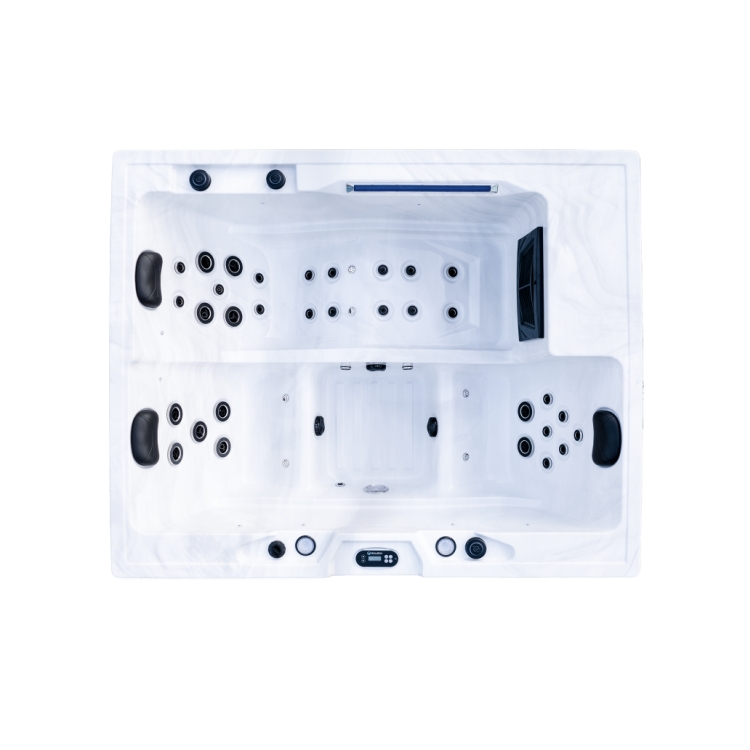
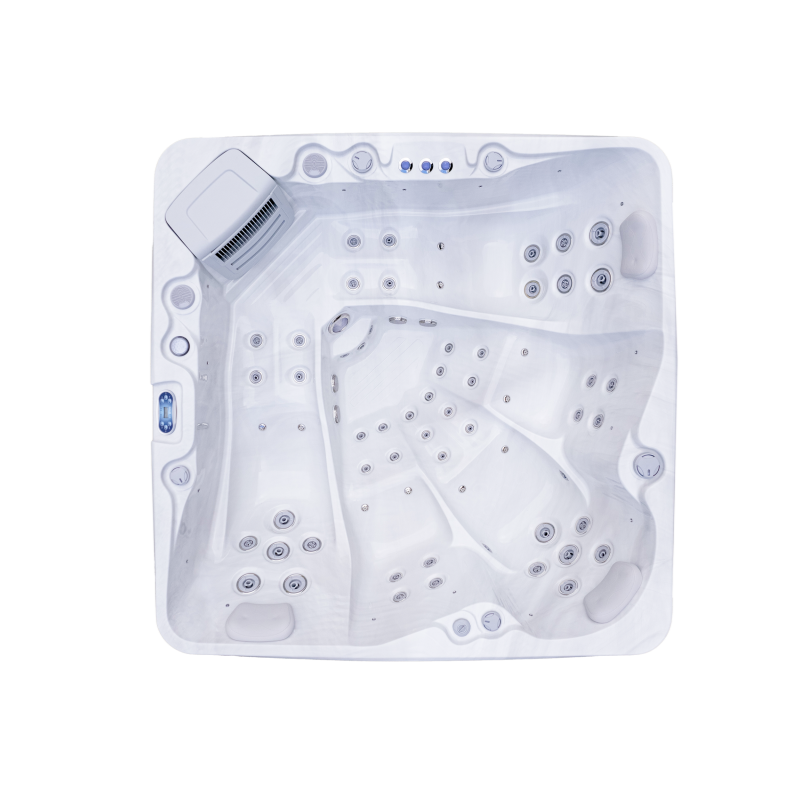
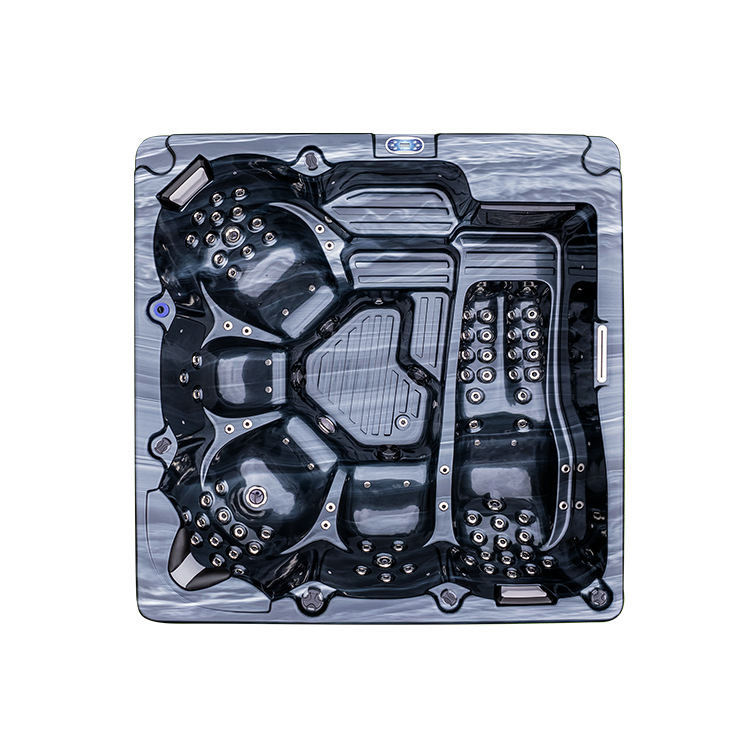
Before deciding to purchase and install a swim spa tub, many people face a crucial question: "Does a swim spa tub need a concrete mat?"
This question seems simple, but it actually concerns the safety, lifespan, stability, and user experience of the equipment.
A swim spa tub is a high-end device combining swimming training and hydrotherapy functions. It is typically heavy and has an internal continuously circulating water system, requiring much higher ground support than a regular bathtub.
Therefore, whether a concrete mat is needed, what conditions the concrete mat should meet, and whether it can be used safely without a concrete foundation are all issues that must be carefully considered before installation.
This article will systematically and professionally answer this question from the perspectives of structural engineering, load-bearing capacity, foundation stability, and installation standards.
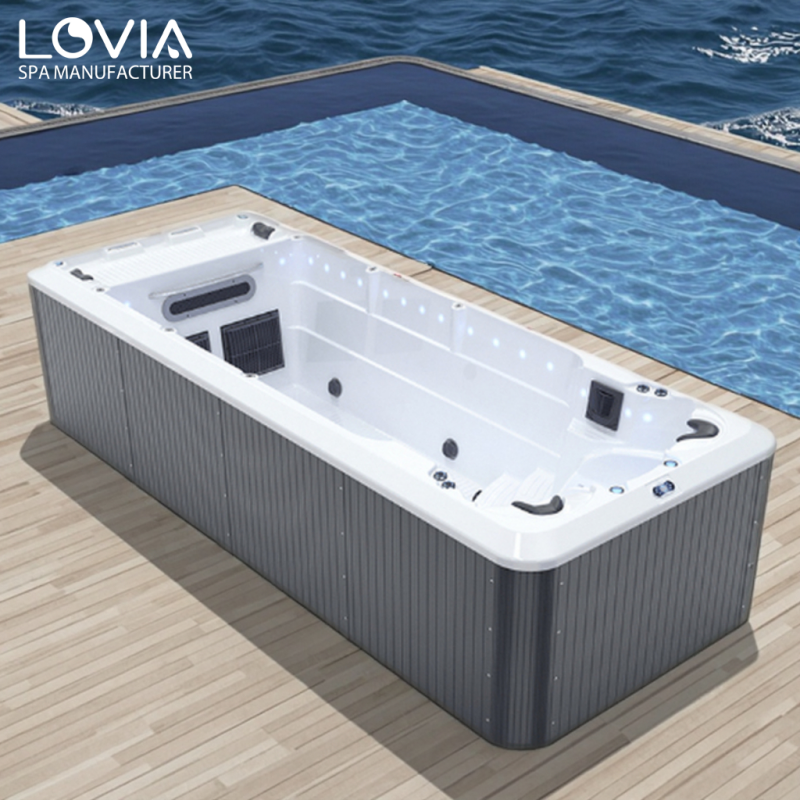
What is a swim spa tub? Why is the installation foundation so important?
A swim spa tub is a multi-functional hydrotherapy device that integrates a heated swimming pool, hydrotherapy, and wellness treatments. Its internal components include a circulation pump, jet system, filtration system, and hydrotherapy nozzles, continuously generating a strong water flow, allowing people to swim or engage in water sports in place.
However, the combined physical weight of this equipment and the total weight of the water is considerable:
Equipment Type | Unloaded Weight | Weight Filled with Water (approx.) | Recommended Foundation Bearing Capacity
Small swim spa tub (3 meters) | 800–1000 kg | 3500–4000 kg | ≥750 kg/m²
Medium (4–5 meters) | 1000–1500 kg | 4500–6000 kg | ≥800 kg/m²
Large (6 meters and above) | 1500–2000 kg | 7000–9000 kg | ≥900 kg/m²
As you can see, even a medium-sized swim spa tub can easily reach several tons in weight when filled with water. Without a solid foundation, the equipment may sink, tilt, deform, or even leak.
Therefore, the choice of foundation directly determines the safety of the installation, and concrete mats have become the standard configuration for most swim spa tub installations.
Do swim spa tubs really need concrete mats?
1. From a structural safety perspective: Concrete mats provide stable load-bearing capacity
The primary requirement for installing a swim spa tub is that the ground must be completely flat, firm, and able to withstand significant weight.
A concrete mat is currently one of the most reliable solutions for the following reasons:
• Even weight distribution: A concrete mat evenly distributes the weight of the several-ton bathtub across the entire contact surface, preventing uneven subsidence caused by localized stress.
• Prevention of equipment structural deformation: Uneven installation surfaces can lead to uneven stress on the bottom of the bathtub, potentially causing shell deformation, pipe misalignment, or even cracking over time. Concrete mats effectively prevent these problems.
• Strong water resistance and moisture resistance: Since swim spa tubs are in constant contact with water, the installation area is prone to dampness. Concrete mats effectively isolate moisture and prevent ground softening.
• Excellent shock absorption and stability: The water pump generates vibrations during operation. The concrete foundation absorbs and disperses these vibrations, extending the equipment's lifespan.
Therefore, from a structural safety perspective, concrete mats are not only recommended but are actually a key foundation for ensuring the long-term stable operation of swim spa tubs.
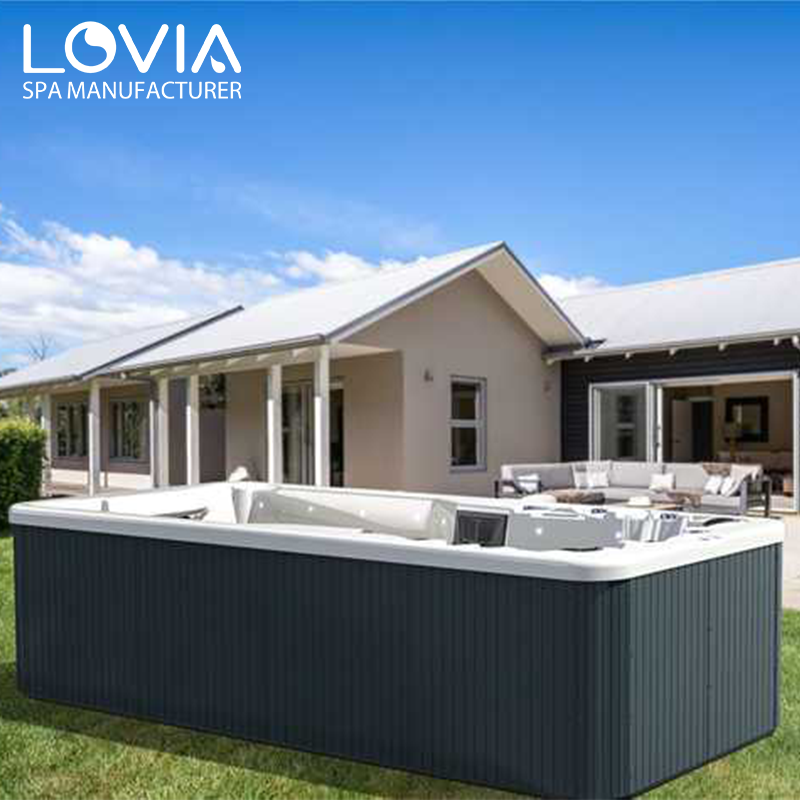
Can a swim spa tub be installed directly without a concrete mat?
1. Under what circumstances can a concrete mat be omitted?
Theoretically, if the ground material is hard enough, flat enough, and can bear the weight, a swim spa tub can be installed without a dedicated concrete mat.
However, this is relatively limited. Common alternatives include:
• Cast-in-place reinforced concrete platform or slab: If the bathtub is installed on an existing concrete terrace, floor, or basement, and the thickness is ≥15cm and the structural strength meets the standards, an additional concrete mat is not required.
• High-strength compacted foundation + moisture barrier: Some outdoor installations can use a combination of a gravel layer + compacted mat + waterproof slab, but this solution requires extremely high construction quality; otherwise, there is still a risk of subsidence.
• Dedicated steel frame support base: Some high-end swim spa tub brands offer steel structure base systems that can be placed directly on hardened ground, but the ground still needs to be flat and firm.
✅ Summary: Installing a swim spa tub without a concrete mat is not absolutely impossible, but the ground strength and stability must be equivalent to the standards of a concrete foundation. Direct installation on any lightweight flooring, wood flooring, or tiled surface is not recommended.
What are the standard thickness and construction requirements for concrete mats?
1. Thickness requirements for swim spa tub concrete mats
The load-bearing capacity and stability of a concrete mat depend on its thickness, reinforcement, and subgrade compaction.
The following are recommended standards:
Bathtub Length | Recommended Concrete Pad Thickness | Reinforcement Recommendations | Foundation Requirements
≤3 meters | 10–12 cm | φ8 steel mesh @150mm | 10cm compacted gravel layer
4–5 meters | 12–15 cm | φ10 steel mesh @150mm | 15cm compacted gravel layer
≥6 meters | 15–20 cm | φ12 double-layer steel mesh | 20cm compacted gravel layer
In addition, the following points should be noted during concrete pad construction:
• The surface must be completely level (error ≤3mm);
• It is recommended to add a waterproof layer or sealant coating to prevent moisture from rising;
• The curing time should be at least 7 days, preferably 14 days before installing equipment;
• A drainage slope (1–2%) should be reserved at the edges to prevent rainwater accumulation.
If constructed properly, the concrete pad can be used stably for decades with almost no maintenance.
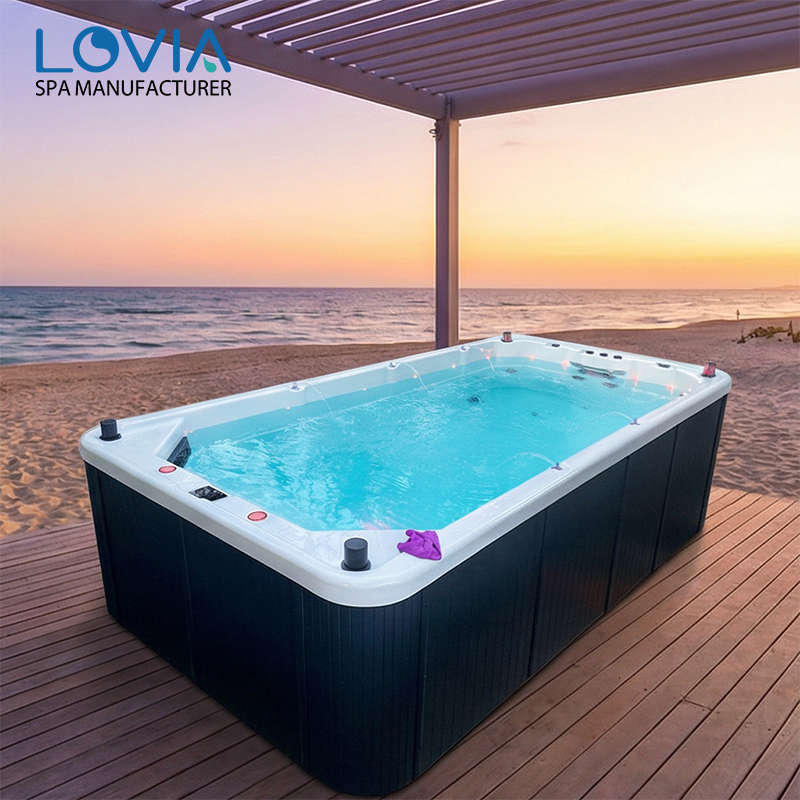
How much larger should the concrete pad be than the swim spa tub?
1. The Importance of Spacing Allowance
The concrete pad should be larger than the bathtub base to facilitate installation and maintenance.
General recommendations:
• Allow 20–30cm on all four sides;
• Allow 50cm if external trim panels or access ramps are planned.
For example, for a 4m × 2.3m swim spa tub, a 4.6m × 2.9m concrete pad is recommended.
This extra space effectively prevents installation errors and facilitates later maintenance, such as drain inspection and cable maintenance.
Concrete Pad vs. Floor Leveling: Which is More Important?
1. Leveling Accuracy Directly Affects User Experience
In swim spa tub installation, leveling accuracy is just as important as concrete strength.
If the concrete pad surface is even slightly tilted, the water surface will be noticeably uneven, affecting the operation of the water flow system.
Ideal requirements are as follows:
• Horizontal error must not exceed 3mm/2m;
• A laser level can be used for leveling;
• If the error is large, high-density rubber pads can be added to the bottom of the bathtub for fine-tuning.
Maintaining perfect levelness is not only related to aesthetics but also directly affects the pressure balance of the circulation system.
Is additional moisture-proofing or drainage design required under the concrete base?
1. Foundation Drainage and Moisture-proofing Layer Design Principles
Swim spa tubs are in constant contact with water, and even without leaks, splashes or rainwater can create a damp environment. Poor drainage can easily lead to foundation softening or mold growth.
Standard practices include:
• Installing a 10–20cm gravel drainage layer under the concrete pad to facilitate water seepage;
• Laying a moisture barrier (such as a PE film or asphalt waterproofing layer) to block ground moisture;
• Pre-installing drainage ditches or concealed pipes around the pad to ensure timely rainwater drainage;
• For outdoor-installed swim spa tubs, a slight slope (approximately 1%) can be created around the foundation to guide water flow outwards.
Good moisture-proofing and drainage design not only protects the concrete pad but also prevents corrosion of metal components caused by prolonged dampness at the bottom of the bathtub.
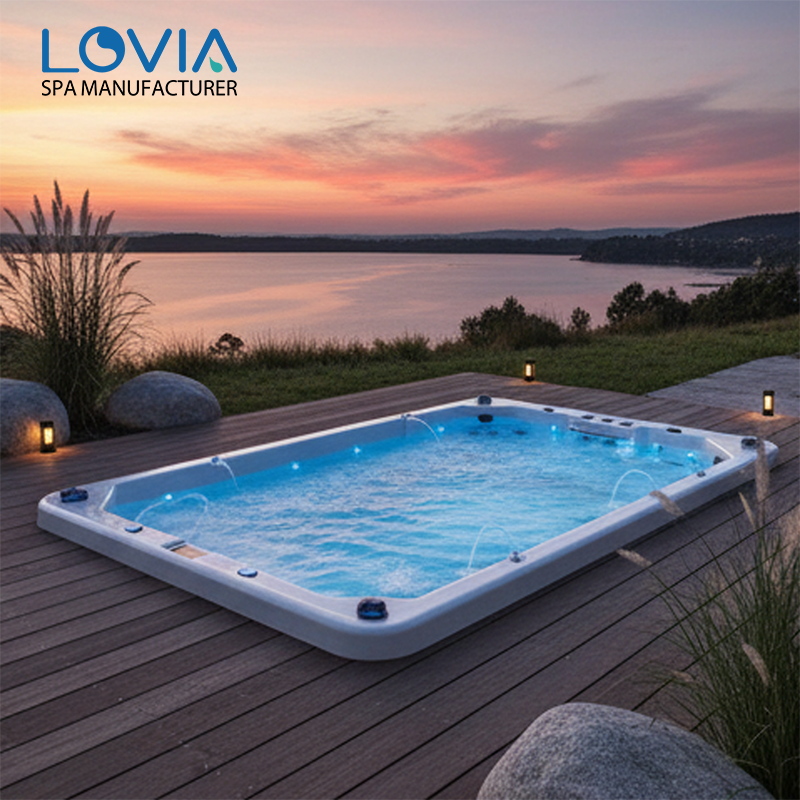
What are the differences in requirements for outdoor and indoor concrete pad installations?
1. The impact of the installation environment on the foundation
Outdoor installation:
• Prioritize foundation drainage and frost heave resistance;
• The concrete layer can be appropriately thickened (15–20cm);
• Anti-slip treatment is recommended for the outer surface.
Indoor Installation:
• The foundation is usually stable, but a moisture barrier and noise insulation should be considered.
• Shock-absorbing rubber pads can be laid on the concrete.
• If installed on a building structure, the load-bearing capacity must be calculated by a structural engineer.
Whether indoors or outdoors, foundation strength is always the core factor. Once the swim spa tub is filled with water, its weight cannot be easily moved, so foundation confirmation before installation is extremely critical.
How to coordinate the concrete pad with the floor covering?
1. Installation suggestions that balance aesthetics and practicality
Many users value aesthetics and want the swim spa tub to blend naturally with the surrounding landscape or floor paving.
On the concrete pad, the following surface treatments can be used:
• Non-slip tile installation: Increases decorative effect and safety;
• Waterproof epoxy coating: Moisture-proof and easy to clean;
• Wood-plastic composite platform or anti-corrosion wood edging: Enhances the overall visual level;
• Exposed concrete + matte non-slip treatment: Simple, industrial style.
However, it is important to note that the thickness of any decorative layer should not affect the horizontal installation of the equipment, and water accumulation should be prevented.
How to Choose a Concrete Pad Solution for Different Terrain Types?
1. Treatment Methods for Slopes, Grasslands, and Sandy Soils
Slope Installation:
• Excavation and layered compaction are required first;
• A stepped concrete structure or retaining wall support can be used.
• Grasslands or Soft Soils
• Topsoil and humus must be removed first;
• Backfill with gravel and compact to ensure a density ≥90%.
Sandy Soils:
• Direct concrete pad construction is not recommended. A gravel layer or foundation reinforcement mesh should be added;
• If the risk of foundation settlement is high, pile foundations or anchor beam structures can be used.
In short, the foundation of the swim spa tub should be based on the three principles of "solid + level + moisture-proof".
How long after the concrete pad construction is completed can the swim spa tub be installed?
It is recommended to wait at least 7–14 days for the concrete to fully cure and for the surface strength to reach the design standard before installation.
Does the concrete pad have to be completely level?
Yes. The horizontal error should be controlled within 3mm; otherwise, the water surface will tilt, affecting the performance.
Can a swimming spa tub be placed directly on a tiled floor?
It is not recommended. Tile floors typically have insufficient load-bearing capacity and a low surface friction coefficient, making them prone to slippage or localized cracking.
Can a swimming spa tub be installed on an indoor floor?
Yes, but the floor slab's load-bearing capacity must be assessed by a structural engineer. Most ordinary floors cannot withstand a weight of several tons.
What if the concrete pad cracks?
Minor surface cracks are generally harmless, but if the crack penetrates or causes unevenness, it should be repaired or re-poured promptly.
