

In discussions about health, weight loss, and body management, "metabolism" is a frequently mentioned keyword. With the increasing popularity of spa hot tubs in homes and vacations, more and more people are wondering: can soaking in a whirlpool spa hot tub really speed up metabolism?
Some believe that sweating, increased heart rate, and elevated body temperature during a hot bath all point to a faster metabolism; others are skeptical, believing that spa hot tubs are merely relaxation tools and have little to do with increased metabolism.
So, from a scientific and physiological perspective, what is the actual relationship between whirlpool spa hot tubs and metabolism?
This article will systematically analyze the real impact of whirlpool spa hot tubs on metabolism, helping you build a clear and rational understanding.
What is Metabolism? Why is Everyone Concerned About It?
Before discussing whether spa hot tubs can speed up metabolism, we first need to clarify what "metabolism" is.
The Basic Meaning of Metabolism
Metabolism refers to the sum of all chemical reactions in the human body, mainly including:
• Anabolic metabolism: building tissues and repairing cells
• Catabolism: breaking down nutrients to obtain energy
In everyday health discussions, people are more concerned with:
• Basal Metabolic Rate (BMR): the minimum energy expenditure required to maintain life at rest.
A higher BMR means the body consumes more energy even without exercise.
Therefore, many people hope to "accelerate their metabolism" in various ways to achieve better weight management and physical condition.
What metabolic-related reactions occur in the body when soaking in a spa hot tub?
When a person enters a spa hot tub, a series of physiological changes do occur in the body, and these changes are related to metabolism.
1. Increased Body Temperature
The water temperature in a whirlpool spa hot tub is usually between 35–40°C, higher than normal human body temperature. To maintain body temperature balance, the body activates regulatory mechanisms.
2. Increased Heart Rate
In a hot environment, the heart needs to pump blood faster to help dissipate heat and maintain blood circulation.
3. Vasodilation
Peripheral vasodilation helps dissipate heat and improves blood flow.
4. Increased Sweating
Sweat evaporation is an important way for the body to dissipate heat, a process that consumes energy.
On the surface, these reactions seem to suggest that the body's energy consumption has increased.
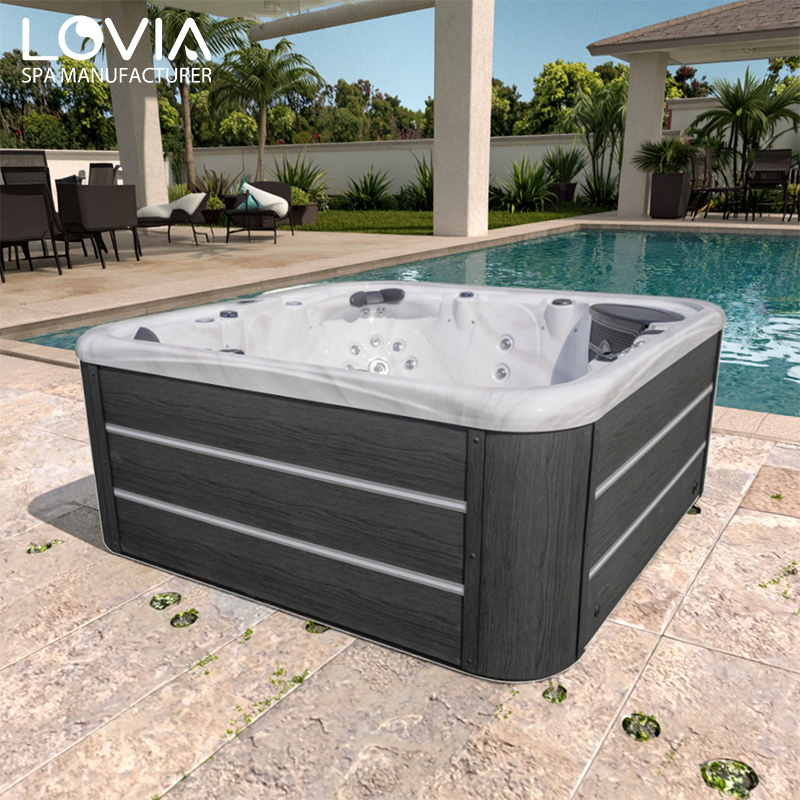
Does a spa hot tub really "accelerate" metabolism?
This is the core question and needs to be understood in different contexts.
Will metabolism increase in the short term?
The answer is: there will be a certain degree of temporary increase.
During a spa hot tub soak, due to:
• Increased heart rate
• Enhanced thermoregulation
• Accelerated blood circulation
The body's energy consumption will be slightly higher than in a completely resting state. This means that the metabolic level increases during the bath.
What kind of increase is this?
It's important to emphasize that this metabolic boost has the following characteristics:
• Passive: Not generated through active muscle work
• Transient: Only exists during the bath or for a short period
• Limited magnitude: The boost is far less than that from exercise
Therefore, strictly speaking, a spa hot tub does not continuously "accelerate" the basal metabolic rate.
How do the effects of a spa hot tub and exercise differ in metabolism?
Many people compare soaking in a whirlpool spa hot tub to exercising, which is a common misconception.
How does exercise boost metabolism?
• Active muscle contraction
• Significant energy expenditure
• Increased muscle mass
• Long-term increase in basal metabolic rate
Characteristics of a spa hot tub:
• Body is in a relaxed state
• Muscles do almost no work
• Limited energy expenditure
• Does not increase muscle mass
In other words, a whirlpool spa hot tub cannot fundamentally increase basal metabolic rate like exercise.
The metabolic changes it brings are closer to:
• Temporary regulation caused by temperature stimulation
• Part of a physiological stress response

Why does soaking in a spa hot tub make people feel like their metabolism is "faster"?
Although the increase in basal metabolism from a spa hot tub is limited, many people experience a very noticeable increase in metabolism. There are several reasons behind this:
1. Sweating is mistaken for a faster metabolism
Sweating does not equal fat burning or a long-term increase in metabolism; it reflects more the body's temperature regulation process.
2. A feeling of "activity" from a faster heart rate
An increased heart rate makes people feel like their body is "working," thus creating the subjective impression of a faster metabolism.
3. A feeling of warmth from improved blood circulation
Faster circulation makes the limbs feel warmer, a feeling easily interpreted as "better metabolism."
4. Improved physical condition after relaxation
After the nervous system relaxes, the body feels more comfortable, which can also be mistaken for an improved metabolism.
These sensations are real, but they are not equivalent to a long-term increase in metabolism.
Can a spa hot tub indirectly affect metabolism by improving sleep?
This is an important perspective.
The Relationship Between Sleep and Metabolism
• Sleep deprivation disrupts hormone secretion
• Affects insulin sensitivity
• Reduces energy utilization efficiency
Proper use of a spa hot tub can help:
• Relax the nervous system
• Relieve stress
• Improve sleep quality
From this perspective, a whirlpool spa hot tub may indirectly support stable metabolic function by improving sleep.
However, it's important to note:
👉 This is "support" and "assistance," not a direct acceleration.

Does a spa hot tub have the same effect on metabolism in different groups?
Not entirely the same.
1. Sedentary individuals and those under high stress
The relaxation effect is more pronounced, potentially indirectly improving their quality of life.
2. Athletes
A whirlpool spa hot tub is more of a recovery tool than a metabolic booster.
3. Middle-aged and elderly individuals
Blood circulation is significantly improved, but basal metabolic rate does not increase significantly.
4. People who want to lose weight through hot tub baths
This is prone to misunderstandings and requires accurate expectations.
Regardless of the group, it's important to understand:
A whirlpool spa hot tub is not a "shortcut" to boosting metabolism.
Will long-term spa hot tub use change your basal metabolic rate?
From the perspective of current physiological mechanisms:
• Spa hot tubs do not increase muscle mass
• Do not change body composition proportions
• Do not reshape energy expenditure structure
Therefore, long-term use of a spa hot tub will not fundamentally change your basal metabolic rate.
It primarily affects:
• Comfort
• Recovery efficiency
• Quality of life
rather than a fundamental increase in metabolic "speed".
How to rationally view the relationship between spa hot tubs and metabolism?
Correct understanding is crucial in health management.
This can be understood as follows:
• Spa hot tub ≠ A tool to boost basal metabolism
• Spa hot tub = An auxiliary method for relaxation and recovery
If you consider a spa hot tub as:
• A means to relieve fatigue
• A way to improve sleep
• Part of daily relaxation
Then its value is clear and reasonable.
However, if you expect a spa hot tub to:
• Significantly boost metabolism
• Achieve fat loss
• Replace exercise
That's an unrealistic expectation.
Is LOVIA SPA Suitable for Commercial Spa Projects?
LOVIA SPA whirlpool hot tub and swim spa products are suitable for commercial projects due to certified quality standards and durable construction. Commercial buyers benefit from bulk purchasing, factory pricing, and customized options. As a manufacturer, LOVIA SPA supports project-based procurement with technical documentation, stable supply schedules, and professional quotations tailored to large-scale installations.
