

During the daily use and maintenance of a swim spa tub, many users tend to overlook a seemingly simple—yet critically important—issue: whether the water level is sufficient.
Many assume that as long as "the water circulates normally" and "the equipment is still running," the water level must be fine. However, in reality, a swim spa's requirements regarding water volume are far more stringent than those of a standard bathtub or swimming pool.
Insufficient water not only compromises the user experience but can also directly lead to circulation system malfunctions, reduced heating efficiency, difficulties in water quality management, and even potential damage to the equipment itself.
So, the questions arise:
How can one determine if a swim spa tub has sufficient water?
Are there clear, definitive criteria for assessment?
Can adding *too much* water cause problems?
Are fluctuations in the water level considered normal?
Drawing upon the structural principles of swim spas, the relationship between water levels and system operation, the symptoms of insufficient or excessive water, scientific diagnostic methods, and common misconceptions, this article provides a systematic and professional breakdown of this issue. Our goal is to help you establish a clear, actionable framework for assessing your swim spa's water levels.
Why is Determining Sufficient Water Levels in a Swim Spa So Important?
Because a swim spa's operational reliance on water volume is far greater than that of standard spa equipment.
Swim Spa Operation Is Highly Dependent on Water Levels
A swim spa tub typically integrates the following systems:
•Circulation and Filtration System
•Current Generation (Jet) System
•Heating System
•Massage Jet System
•Water Level Sensors or Safety Protection Devices
Virtually all of these systems rely on a stable and sufficient water supply to function correctly.
If the water level drops too low, the following issues may arise:
•The water pump may draw in air.
•Water flow may become unstable or erratic.
•There is a risk of the heater "dry-firing" (operating without water).
•Filtration efficiency may decrease.
•The system may frequently trigger alarms or automatically shut down.
Therefore, determining whether your swim spa tub has sufficient water is not a "discretionary" matter; it is a critical component of fundamental maintenance.
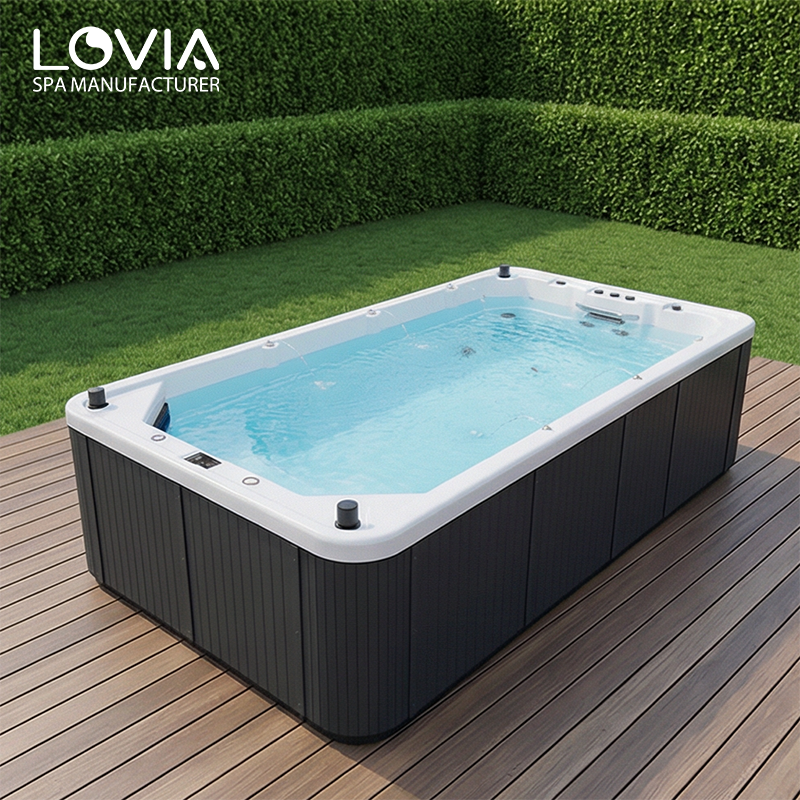
What Exactly Constitutes "Sufficient Water" in a Swim Spa?
For many users, "sufficient water" remains a vague, abstract concept. In reality, however, it carries a precise technical definition.
Sufficient Water Level ≠ Filling to the Brim
For a swim spa tub:
•"Sufficient water level"
refers to the water level reaching and stabilizing within the normal operating range designed for the equipment.
•It does *not* mean:
that "more water is better," or that you should arbitrarily fill it right up to the rim.
The Logic Behind Swim Spa Tub Water Levels
Most swim spa tubs are designed with clearly defined parameters:
•Minimum Safe Water Level
•Recommended Operating Water Level
•Maximum Safe Water Level
Determining whether the water level is sufficient essentially boils down to verifying whether the current level falls within the recommended operating range.
How can you determine if a swim spa tub has sufficient water based on the water level height?
This is the most intuitive and commonly used method of assessment.
1. Does the water level cover all the intake ports?
The interior of a swim spa tub typically features:
•Circulation intake ports
•Filter intake ports
•Current-generating system intake ports
The rule of thumb is very clear:
All intake ports must be completely submerged—covered by the water—with a certain margin of water sitting above them.
If the water level drops below any of these intake ports, you can immediately conclude:
The swim spa tub has insufficient water.
2. Does the water level align with the equipment's indicator markings?
The inner walls of many swim spa tubs feature:
•Water level calibration lines
•"MIN / MAX" indicators
•Recommended water level markers
These markings are not merely decorative; they are established based on the equipment's specific operating parameters.
•Water level below the recommended line → Insufficient water
•Water level consistently above the maximum line → Excessive water
The correct state is: The water level remains stable in the vicinity of the recommended level.
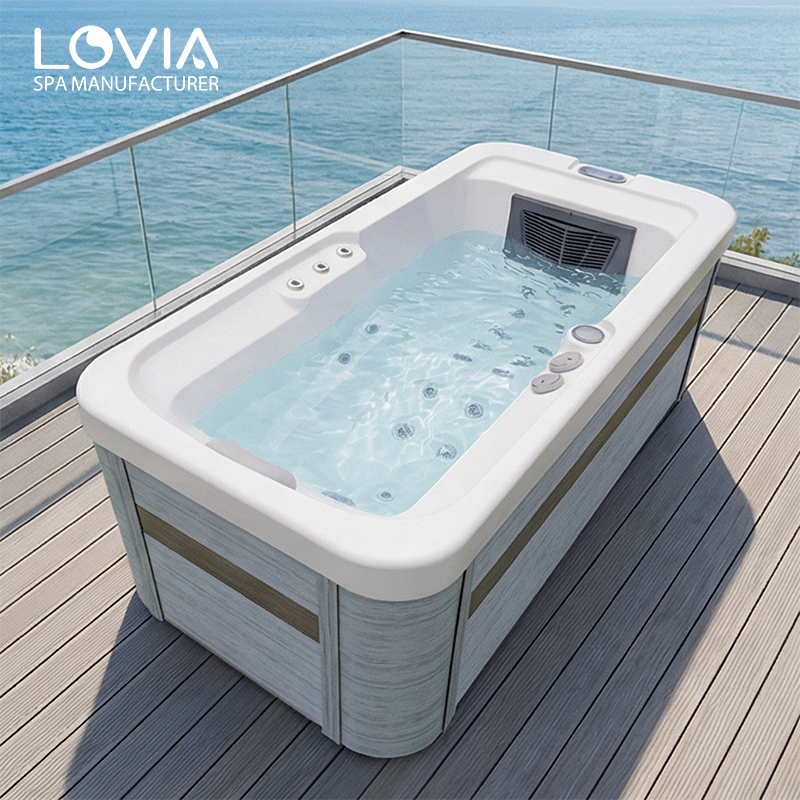
What are the obvious signs of insufficient water in a swim spa tub?
Even in the absence of calibration markings, the swim spa tub will "alert" you to an insufficient water level through changes in its operating behavior.
1. Does abnormal pump noise indicate insufficient water?
When a swim spa tub has insufficient water, common symptoms include:
•The pump emitting a high-pitched or whining sound
•Intermittent "dry-running" or gurgling sounds
•Water flow that fluctuates—suddenly becoming strong, then weak
These are all potential signals that the pump is drawing in air, a condition typically linked directly to an excessively low water level.
2. Has the current-generating or massage jet flow become noticeably weaker?
The current-generating system in a swim spa tub requires stable water pressure to function correctly. If you observe:
•Intermittent water flow
•Significantly reduced thrust/pressure
•Water exiting the jets is mixed with a large amount of air bubbles
Assuming there are no blockages in the jets, insufficient water volume is a highly probable cause.
3. Is slow heating speed related to the water level?
Insufficient water volume can lead to:
•An unstable operating environment for the heater
•The system automatically limiting power output
•Frequent cycling (starting and stopping) of the heating element
Therefore, if you notice that your swim spa tub is heating up unusually slowly, you should also check to ensure the water level meets the required standards.
4. Is having too much water in the swim spa tub necessarily safe?
Many swim spa tub users, upon discovering that the water level is low, will add a large amount of water all at once—sometimes filling it to the very brink of overflowing.
However, in reality, having too much water presents its own set of problems.
Potential consequences of excessive water volume:
•Increased risk of overflowing as the water expands (due to heating)
•Water entering the equipment compartment, thereby increasing electrical safety risks
•Dilution of sanitizer concentrations, compromising water quality management
•Exceeding the structural load-bearing limits of the design
Therefore, determining whether the water volume in a swim spa tub is adequate is not a matter of "the more, the merrier," but rather ensuring it falls within the "reasonable and designated range."
Why does the water volume in a swim spa tub gradually decrease during use?
Even in the absence of any obvious leaks, it is normal for the water level in a swim spa tub to drop over time.
Reasons for water loss in a swim spa tub:
•Splashing and spillage during use
•Natural evaporation caused by elevated water temperatures
•Water being carried out of the tub by users as they enter and exit
•Losses incurred during air purging or backwashing processes
Precisely for these reasons, regularly checking the water level is a crucial and indispensable part of routine swim spa tub maintenance.
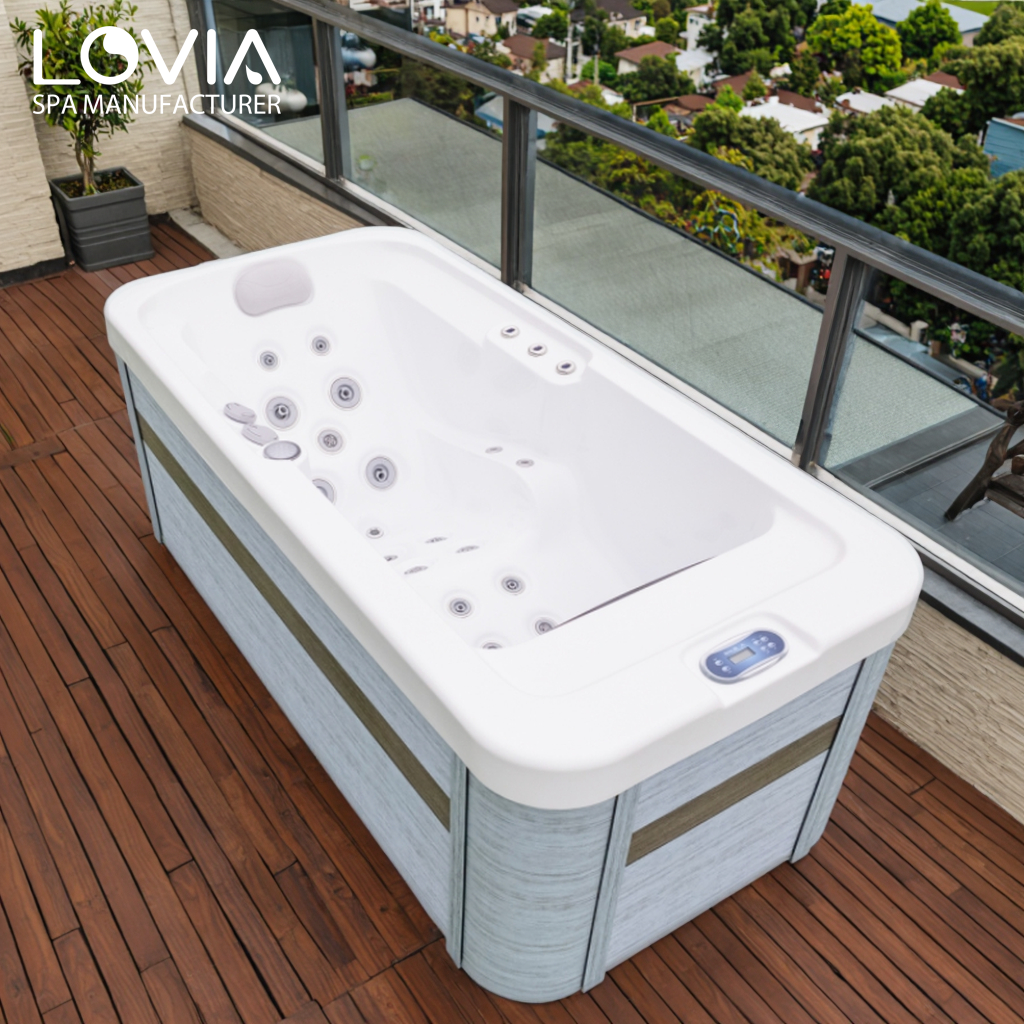
How often should you check the water level in your swim spa tub?
From a professional maintenance perspective, the following guidelines are recommended:
•High-frequency usage: Visually check the water level daily.
•Low-to-medium frequency usage: Check once every 2–3 days.
•Extended continuous operation: Check both before and after use.
Checking the water level is a simple task, yet it serves as an effective preventive measure against a wide range of potential issues.
What are some common misconceptions regarding water levels in swim spa tubs?
Misconception #1: "If the equipment is still running, the water level must be fine."
In reality, many swim spa tubs will continue to operate during the initial stages of low water levels; however, they are no longer functioning under optimal conditions.
Misconception #2: If there appears to be a lot of water, it must be sufficient.
Visual assessment can easily be misleading; the true standard for judgment is always: Has the recommended operating water level been reached?
Misconception #3: If I fill it to a very high level once, I won't have to worry about it later.
Water levels fluctuate dynamically; a swim spa tub requires continuous, consistent water level management—not a one-time fix.
