

As healthy lifestyles gain global popularity, outdoor swim spa tubs—which combine swimming, fitness, hydrotherapy, and leisure—are becoming key amenities for high-end residences, villa gardens, boutique guesthouses, wellness centers, and resort hotels. Compared to traditional swimming pools, outdoor swim spas have a smaller footprint, offer year-round usability, and entail lower maintenance costs. They also provide features such as counter-current swimming, hydrotherapy massage, and constant-temperature spa experiences, driving steady growth in market demand.
However, a seemingly minor yet common issue—low water levels—frequently impacts equipment longevity and leads to the need for repairs.
Many users assume that as long as there is some water in the swim spa tub, the equipment will function normally. They may not top up the water immediately when the level drops slightly. Some commercial operators delay refilling until the water level has dropped significantly to conserve water, while others restart the system without fully restoring the water level after changing filters, cleaning the tub, or performing drainage maintenance. It is precisely these seemingly insignificant actions that often expose the swim jacuzzi spa to potential risks.
Statistics from the international spa industry regarding after-sales service indicate that a significant proportion of issues—such as circulation pump failures, heater malfunctions, and water flow alarms—are linked to prolonged operation with low water levels or running the system without water. Often, these malfunctions are not due to equipment defects but rather a lack of proper maintenance knowledge on the part of the user.
In reality, a modern outdoor swim spa tub is not merely a water container; it is a complex system comprising circulation, heating, filtration, counter-current, hydrotherapy massage, smart control, and water treatment systems. Each core component relies on stable water circulation to function correctly, and maintaining an adequate water level is fundamental to the safe operation of the entire system.
Therefore, understanding the proper water level standards, the potential consequences of low water levels, and how to maintain water levels correctly can help avoid unnecessary repair costs and effectively extend the equipment's lifespan.
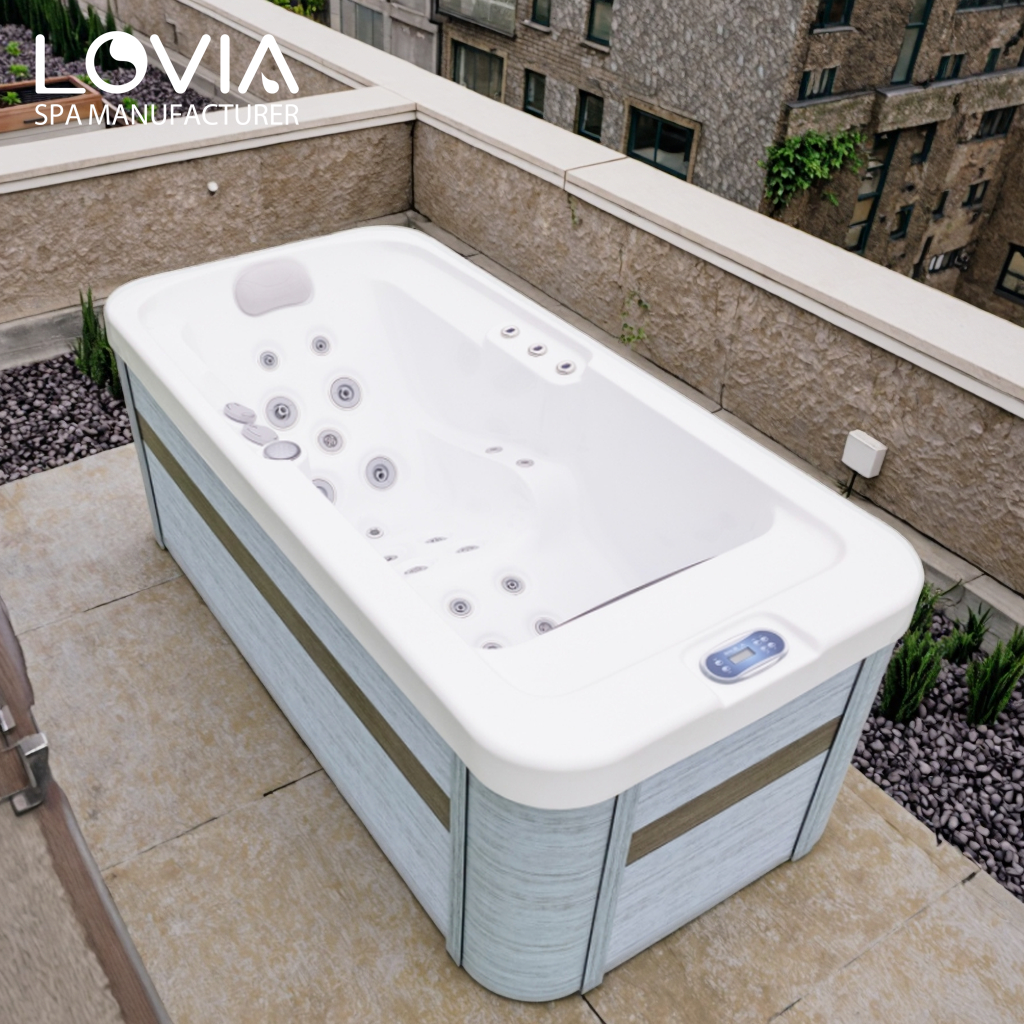
Why is the water level in an outdoor swim spa so important?
For many users new to outdoor swim jacuzzi spas, the primary focus tends to be on counter-current swimming speeds, the number of massage jets, and temperature stability or heat retention; however, they often overlook the fact that the water level is a fundamental requirement for the system's operation.
Unlike standard bathtubs, outdoor swim spa tubs are designed for continuous circulation. They comprise multiple integrated modules—such as circulation pumps, counter-current propulsion pumps, filters, heaters, ozone generators or UV sterilization systems, and control units—that work in concert through the flow of water.
Under normal operating conditions, the circulation pump continuously draws water into the filtration system, where it is heated and purified before being returned to the spa. When the counter-current swimming mode is activated, high-power pumps rapidly propel a large volume of water to create a steady current. If the water level is insufficient, the intake may fail to draw enough water, thereby compromising the operation of the entire system.
From an engineering perspective, most outdoor swim spa tub manuals specify a recommended water level range—usually requiring the water to remain above the filter or near a designated fill line. This requirement is not intended to complicate maintenance but is a fundamental operational necessity for the equipment's design.
What are the consequences of a low water level in an outdoor swim spa?
1. Risk of the circulation pump running dry
The circulation pump is a critical component of the outdoor swim spa tub, responsible for filtration, heating, and water circulation.
The pump itself lacks the ability to actively prime or draw water; instead, it relies on a continuous flow of water to operate. If the water level drops to or below the intake, air can enter the plumbing, causing the pump to draw in air rather than water.
This condition is commonly referred to as "running dry" (or dry running).
When a pump runs dry, the lack of water for lubrication and heat dissipation causes the temperature of internal mechanical seals to rise rapidly. Prolonged operation in this state can lead to:
•Seal degradation;
•Impeller wear;
•Activation of the pump's overheat protection;
•Reduced motor lifespan.
While some high-quality outdoor swim spa tubs are equipped with flow detection and automatic protection features, repeated operation at low water levels over time will still accelerate equipment wear and tear.
2. The heater may fail to operate correctly
Modern outdoor swim spa tubs typically utilize a flow-through heating system.
This means the heater does not heat the entire volume of water directly; instead, it facilitates continuous heat exchange via the circulating water flow.
If the water level is insufficient, causing the circulation flow rate to drop, the heater may experience the following issues:
•Flow rate alarms;
•Automatic cessation of heating;
•Significant temperature fluctuations;
•Reduced heating efficiency.
For units lacking robust protection mechanisms, extreme cases could even result in damage to the heating element due to the lack of adequate water flow for cooling.
Consequently, most international brands incorporate low-water-level protection as a key feature of their control systems.
3. Impact on counter-current swimming performance
One of the defining features of an outdoor swim spa tub is its ability to provide a continuous, steady counter-current flow.
The counter-current system typically employs a high-power propulsion pump, with an instantaneous flow rate far exceeding that of standard spa massage pumps.
If the water level is too low, the propulsion pump may draw in air, causing the user to notice:
•Fluctuating water flow intensity;
•Reduced propulsion force;
•Excessive air bubbles;
•Unstable water flow.
In the long run, this not only compromises the swimming experience but also increases the operational load on the propulsion pump.
4. Accelerated contamination of the filtration system
Many users are unaware that low water levels also impair the efficiency of the filtration system.
A drop in circulation volume means less water passes through the filter per unit of time, resulting in:
•Slower removal of impurities;
•Accelerated deterioration of water quality;
•Reduced sanitizer efficiency;
•Increased risk of microbial proliferation.
Therefore, maintaining a proper water level is essential for preserving good water quality.
Why does the water level in an outdoor swim jacuzzi spa drop?
Many users assume that the water level remains constant unless there is a leak.
In reality, a drop in water level is a natural occurrence during the normal use of an outdoor swim spa tub.
Primary reasons include:
Evaporation loss. When the water temperature is consistently maintained between 36°C and 40°C, continuous evaporation occurs. Evaporation rates accelerate further in dry winter conditions, hot summer weather, or windy areas.
Water carried away by users. After each use, a certain amount of water is removed from the spa by the users' bodies, swimwear, and towels. If the unit is used frequently by multiple people, the cumulative water loss will be more significant.
Backwashing and maintenance: Water is also discharged during filter cleaning, cartridge replacement, and certain maintenance procedures.
Therefore, even if there are no leaks, users are advised to check the water level regularly.
How do you determine if the water level in an outdoor swim spa is too low?
The simplest method is to observe the recommended water level line marked by the manufacturer.
Generally, the normal water level should meet the following criteria:
•Above all suction inlets;
•Above the filter intake;
•Close to the officially recommended level;
•No vortex formation (air suction) when massage and counter-current functions are active.
If a noticeable vortex forms near the suction inlet after the circulation system starts, it usually indicates the water level is too low and needs to be topped up.
Additionally, check the water level if the equipment frequently exhibits the following issues:
•Heating stops;
•Water flow alarm triggers;
•Increased circulation pump noise;
•Abnormal water output from massage jets;
•Control system displays a flow-related fault code.
How do you correctly top up the water level in an outdoor swim spa tub?
While topping up is simple, there are a few details to consider.
First, use clean tap water and avoid a high-speed stream hitting the filter area directly, which helps minimize air entering the plumbing.
Second, verify that the water level falls within the manufacturer's recommended range after topping up.
If an airlock occurs due to low water levels, bleed the air according to the manual's instructions before restarting the circulation system.
Furthermore, after topping up, re-test the following:
•pH level;
•Sanitizer concentration;
•Total alkalinity;
This is because the newly added tap water may alter the overall water quality balance.
How can you prevent the outdoor swim jacuzzi spa from operating with a low water level for extended periods?
The most effective method is to establish a routine inspection schedule.
For home users, checking the water level at least once a week is recommended; for hotels, vacation rentals, and commercial operations, daily checks are advised due to higher usage frequency.
Additionally, consider adopting these maintenance habits:
•Check the water level after each use;
•Top up the water promptly after cleaning the filter;
•Verify the water level after replacing any portion of the water;
•Increase inspection frequency during periods of prolonged high-temperature operation. These simple measures can effectively reduce the risks associated with low-water-level operation.
How does LOVIA® enhance the operational reliability of outdoor swim spas?
As a company dedicated to the R&D and manufacturing of spas and swim spa tubs, LOVIA® places great emphasis on the integrated design of the entire system. During product development, for instance, the company carefully balances the compatibility of the circulation system, water flow paths, filtration efficiency, thermal insulation structure, and intelligent control systems to ensure overall operational stability.
LOVIA® operates a modern 45,000-square-meter production facility with 12 specialized production lines; its products are exported to numerous countries and regions, and the company continuously optimizes its intelligent control, water treatment, and energy-saving technologies. This systematic design approach enhances the stability and ease of maintenance of the swim jacuzzi spas over long-term use.
Of course, even the best equipment requires proper usage. Maintaining the correct water level, performing regular filtration system maintenance, and following the manufacturer's care recommendations are essential prerequisites for ensuring the long-term, stable operation of an outdoor swim spa tub.
How can you establish a sound maintenance routine for your outdoor swim spa?
Preventive maintenance is more cost-effective and yields better results than reactive repairs.
Users are advised to establish a regular maintenance schedule—such as checking water levels, water quality, and filter status weekly; inspecting the circulation system and jets monthly; and performing a partial water change and deep cleaning quarterly.
For commercial projects, it is also advisable to maintain equipment inspection logs and incorporate water level checks into daily management procedures. This not only helps identify issues early but also extends the overall lifespan of the swim spa tub and reduces long-term operating costs.
FAQ
1. How often should the water level of an outdoor swim spa tub be checked?
For residential users, a weekly check is recommended. If evaporation is rapid (e.g., in summer) or usage frequency is high, checks every 2–3 days are advisable; for commercial projects like hotels or vacation rentals, daily checks are recommended.
2. At what point should water be added to an outdoor swim spa tub?
Generally, the water level should be maintained near the manufacturer's recommended line to ensure that filter inlets and all suction ports remain fully submerged; it is not advisable to wait until the water level has dropped significantly before refilling.
3. Will a low water level inevitably burn out the circulation pump?
Not necessarily. While most high-quality outdoor swim spa tubs feature flow detection and overheat protection, operating at low water levels for extended periods increases pump wear and can shorten the equipment's lifespan; therefore, this practice should be avoided.
4. Is it necessary to re-test water quality after refilling the outdoor swim spa tub?
Testing is recommended. Freshly added tap water can alter pH levels, total alkalinity, and sanitizer concentrations; making appropriate adjustments helps maintain optimal water quality.
5. What are the main spa products manufactured by LOVIA®?
LOVIA® has long specialized in the spa equipment sector, with a product portfolio that includes outdoor swim spa tubs and outdoor hot tubs. The company continuously optimizes its offerings—focusing on smart controls, energy-efficient insulation, water treatment systems, and overall manufacturing processes—to meet the diverse needs of the residential, commercial, and wellness markets.
