
How to Fix Leaks in Outdoor Hot Tubs? — A Maintenance Guide for Leaking Outdoor Spa Equipment
For any outdoor spa hot tub owner, leaks are almost invariably one of the most vexing issues to encounter. According to statistical data from the after-sales service sector for spa equipment in North America and Europe, over 60% of all repair cases throughout a whirlpool spa hot tub's entire lifecycle are related to the water supply, circulation, or sealing systems—and leaks account for a significant proportion of these cases.
Upon noticing a drop in their whirlpool jacuzzi hot tub's water level, many users' first reaction is often to suspect a defect in product quality; however, the actual causes behind a leak are often far more complex than one might imagine.
Regrettably, many outdoor spa hot tub manufacturers currently on the market make significant compromises—particularly regarding plumbing layout, bonding techniques, insulation structure, and ease of future maintenance—in an effort to cut costs. While some lower-end products may offer attractive pricing during the sales phase, they often begin to exhibit issues such as loose fittings, aged seals, and cracked pipes after just two or three years of use.
When faced with a leaking whirlpool spa hot tub, users often struggle to quickly pinpoint the source of the fault; this not only results in high repair costs but can also render the equipment inoperable for weeks or even months.
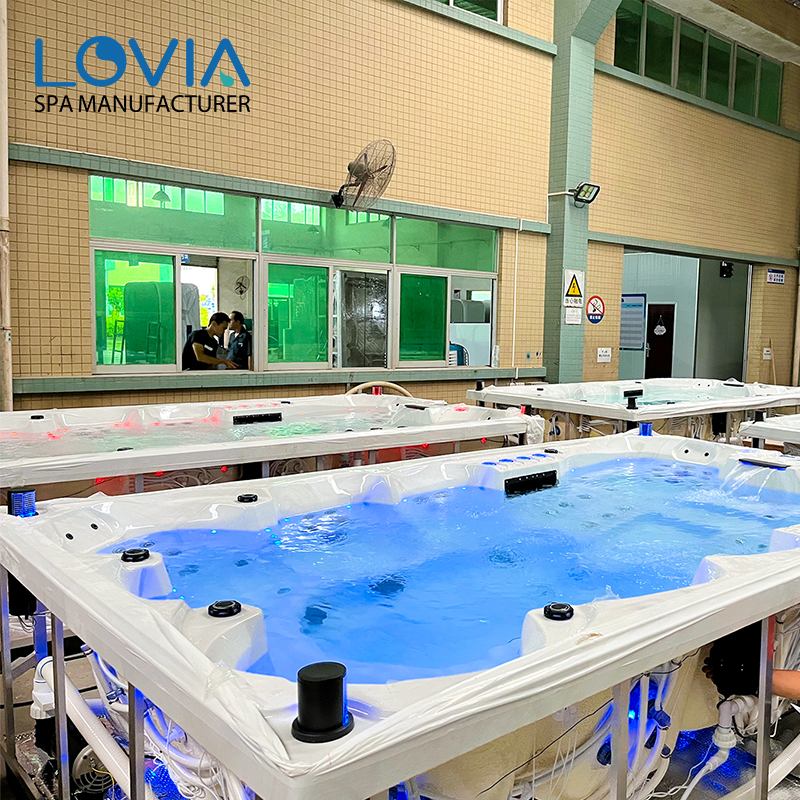
In contrast, established outdoor jacuzzi hot tub manufacturers typically prioritize long-term reliability during the design phase. For instance, LOVIA®—a Chinese manufacturing brand with over thirty years of deep expertise in the spa equipment industry—operates a 45,000-square-meter production facility housing 12 production lines, backed by a robust quality control system encompassing IQC, IPQC, and OQC protocols.
During the manufacturing process, every tenth spa unit undergoes a 30-minute leak test at a pressure of 0.3 MPa, while 100% functional testing is performed on every unit prior to shipment. This rigorous approach effectively mitigates the risk of future leaks right from the source. This manufacturing philosophy adopted by LOVIA® effectively provides a crucial safeguard for users regarding future maintenance needs.
So, when an outdoor jacuzzi hot tub does develop a leak, how should one proceed to scientifically diagnose, accurately troubleshoot, and efficiently resolve the issue? This article offers a comprehensive analysis from a professional perspective.
Why Do Outdoor Spa Hot Tubs Leak?
Outdoor jacuzzi hot tubs are complex pieces of equipment that operate continuously within an environment characterized by high temperatures, high humidity, and high-pressure water circulation. Typically, the water temperature is maintained between 37°C and 40°C, while the circulation pump operates for several hours a day—or even continuously, around the clock. In such an environment, all materials are subjected to thermal expansion and contraction, mechanical vibration, and chemical corrosion.
Leaks in outdoor spa hot tubs can generally be categorized into the following six major types:
Type 1: Aging Plumbing System
This is the most common cause of leaks. The interior of an outdoor jacuzzi hot tub is crisscrossed with PVC piping used to connect the jets, filters, heaters, and circulation pump. As the unit ages, the PVC material gradually becomes brittle.
This is particularly true in environments characterized by:
•Regions experiencing frequent freeze-thaw cycles in winter;
•Outdoor settings with significant temperature fluctuations between day and night;
•Areas exposed to prolonged ultraviolet (UV) radiation;
Under these conditions, micro-cracks are highly prone to developing at the pipe joints.
When the outdoor jacuzzi hot tub is in operation, the pressure generated by the pump continuously expands these cracks, eventually resulting in a noticeable leak.
Type 2: Aging Jet Seals
Many spa owners overlook the importance of the jet system. In fact, a standard outdoor jacuzzi hot tub is typically equipped with anywhere from 20 to 60 jets.
Behind each jet, the following components are installed:
•An O-ring seal;
•A silicone gasket;
•A locking nut.
Since these components are constantly submerged in hot water and exposed to various chemicals, their average lifespan is approximately 3 to 5 years. Once these seals harden, the outdoor spa hot tub may begin to develop slow, gradual leaks.
Type 3: Leaks from the Circulation Pump
The circulation pump serves as the "heart" of the whirlpool spa hot tub. Data indicates that approximately 25% of all hot tub leaks are directly related to the pump assembly.
Common issues include:
•Failure of the mechanical seal;
•Cracks in the pump housing;
•Loose couplings;
•Damaged flange gaskets.
Users often notice that the leakage intensifies while the equipment is running, yet diminishes significantly once the unit is shut off. This phenomenon is frequently a critical indicator of a pump malfunction.
Type 4: Leaks in the Heater Assembly
Modern outdoor jacuzzi hot tubs typically utilize a 3kW electric heating system. Prolonged operation at high temperatures can lead to:
•Aging of the heater flange;
•Deformation of the sealing ring;
•Corrosion of the stainless steel chamber;
When these issues arise, persistent water accumulation often forms at the bottom of the whirlpool spa hot tub.
Category 5: Leaks at Spa Jacuzzi Tub Filtration System Connections
The spa jacuzzi tub filter plays a crucial role in maintaining water quality. However, after frequent removal for cleaning, issues such as worn threads or compression deformation of gaskets can occur. Many outdoor jacuzzi hot tubs suddenly develop leaks following seasonal maintenance; the root cause is often hidden within the filter connections.
Category 6: Structural Damage to the Tub Shell
Although relatively rare, this category presents the greatest repair challenge.
Examples include:
•Cracks in the acrylic surface;
•Delamination of the fiberglass layer;
•Damage caused by external impact;
Once these problems occur, the outdoor jacuzzi hot tub may require professional structural repair.
How to Quickly Determine if Your Outdoor Hot Tub Is Truly Leaking?
Many users mistake normal evaporation for a leak. In reality, an outdoor spa hot tub experiences natural water loss every day.
In Summer: Daily evaporation accounts for approximately 0.5% to 1% of the total water volume.
In Winter: Due to the contact between hot water and cold air, evaporation rates can reach as high as 2% to 3% per day.
For example:
For an outdoor spa hot tub with a 1,500-liter capacity, a daily water loss of 10 to 15 liters in the summer is considered normal.
The diagnostic method is quite simple.
Method 1: The 24-Hour Static Test
The steps are as follows:
1.Turn off all circulation equipment in the whirlpool spa hot tub;
2.Mark the current water level;
3.Wait for 24 hours;
4.Measure the change in the water level.
If the water level drops by more than 5 millimeters, it can generally be concluded that a leak exists.
Method 2: The Bucket Test
Place a bucket filled with water inside the outdoor jacuzzi hot tub.
After 24 hours, compare:
•The drop in the water level inside the bucket;
•The drop in the water level of the spa jacuzzi hot tub;
If the water level in the whirlpool spa hot tub has dropped significantly more than that in the bucket, it indicates a genuine leak.
Outdoor Jacuzzi Hot Tub Leak Troubleshooting Process — A Detailed Guide
Professional outdoor spa repair technicians typically follow the logic outlined below.
Step 1: Identify the Location of the Leak
Observe the area where water has pooled.
For example: Water pooling in the center at the bottom of the spa equipment.
Potential sources:
•Drain valve;
•Circulation pump;
•Heater;
For example: One side remains continuously damp.
Potential sources:
•Jet system;
•Pipe fittings/joints;
For example: Water pooling in a specific corner.
Potential sources:
•Shell cracks;
•Localized pipe damage;
Step 2: Check the Spa Jacuzzi Tub's Operating Status
Start the outdoor jacuzzi hot tub and observe any changes. If the leak becomes significantly worse while the unit is running, the problem likely originates from the pressurized system. If the leak persists even when the unit is turned off, it is more likely an issue with the shell, the drain valve, or static connections.
Step 3: Remove the Access Panel
Inspect the following:
•Pump base;
•Pipe connections;
•Valve system;
•Heater assembly;
Use a flashlight to observe the direction in which the water traces spread. Experienced repair technicians can often trace the water marks backward to pinpoint the actual source of the leak.
Common Repair Solutions for Outdoor Spa Hot Tub Leaks
1. Repairing Cracks in Spa Jacuzzi Tub Plumbing
For minor cracks: Use professional PVC repair adhesive. For severe cracks: It is recommended to replace the affected section of piping entirely.
Note: Relying solely on standard silicone sealant to plug leaks is typically not a long-term solution for outdoor jacuzzi hot tubs.
2. Replacing Seals/Gaskets
This is often the most cost-effective repair. A new EPDM seal typically costs less than a few dollars, yet it could resolve a leak that has persisted for months.
Recommendation: Replace all critical seals and gaskets simultaneously every 3 to 5 years.
3. Pump Repair
If a mechanical seal failure is confirmed: The seal assembly can be replaced independently. If the motor bearings show signs of wear: It is often more economical to replace the entire circulation pump unit.
4. Spa Hot Tub Heater Maintenance
Inspect the following:
•Flange gaskets;
•Temperature sensor ports;
•Welds on the heating chamber;
Replace the entire heater assembly if necessary.
5. Acrylic Shell Repair
For hairline cracks: Use an acrylic repair resin. For structural damage: We recommend contacting the after-sales service team of a professional whirlpool spa hot tub manufacturer for assistance.
How to Prevent Leaks in Outdoor Jacuzzi Hot Tubs?
Compared to repairs, prevention is clearly of greater importance.
1. Regularly Check Water Levels
We recommend recording the water level once a week. Consistent monitoring helps detect potential leaks in your outdoor spa hot tub at an early stage.
2. Maintain Water Chemistry Balance
Ideal Ranges:
•pH: 7.2–7.8
•Total Alkalinity: 80–120 ppm
•Free Chlorine: 1–3 ppm
An imbalance in chemical levels can accelerate the aging and deterioration of seals.
3. Winterization (Freeze Protection)
For users in cold climates: You must ensure that the whirlpool spa hot tub maintains a minimum circulation flow during the winter months. The expansion caused by freezing water is one of the primary causes of ruptured plumbing lines.
4. Regularly Maintain the Jet System
Inspect the following at least once a year:
•The tightness of the jets;
•The condition of the seals/gaskets;
•The uniformity of the water flow;
Performing these checks can significantly reduce future maintenance costs for your whirlpool spa hot tub.
5. Choose a High-Quality Spa Equipment Manufacturer
In reality, the majority of severe leaks in outdoor jacuzzi hot tubs stem from issues related to the manufacturing process itself.
For instance, LOVIA®—one of China's top five spa equipment brands—utilizes Aristech® acrylic materials imported from the USA, combined with a 25–50 mm closed-cell foam insulation structure. This design offers distinct advantages in terms of equipment stability and plumbing protection.
Furthermore, LOVIA® products are widely exported to mature markets such as the USA, Canada, the UK, Germany, and Australia, and meet rigorous international certification standards (including CE, ETL, CB, and EMC). This quality management system—honed through long-term exposure to international markets—effectively minimizes the risk of structural leaks during the whirlpool jacuzzi hot tub's operational lifespan.
For commercial hotels, resorts, and high-end residential projects, while the initial equipment purchase cost is certainly a factor, the total lifecycle maintenance cost is often even more critical. Choosing a whirlpool jacuzzi hot tub brand with a proven track record in the market typically results in fewer subsequent repairs and extends the overall service life of the equipment.
FAQ: Common Questions About Hot Tub Leaks
Q1: Is it normal for my spa jacuzzi tub to lose a small amount of water every day?
Yes, this is normal. Outdoor jacuzzi hot tubs naturally lose water due to evaporation. A daily drop of 5–15 liters is generally considered within a reasonable range, depending on factors such as ambient temperature, wind speed, and water temperature.
Q2: Can a whirlpool spa hot tub still be used after it starts leaking?
It is not recommended. Continuous leaking can cause the circulation pump to run dry, damage the heater, and expose the electrical system to moisture; therefore, the cause should be diagnosed and repaired as soon as possible.
Q3: At what stage in its lifespan is a spa jacuzzi tub most prone to leaks?
Based on industry experience, whirlpool jacuzzi hot tubs are most susceptible to issues such as aging seals and loose connections between the third and eighth year of use; consequently, preventive maintenance should be prioritized during this period.
Q4: How much does it typically cost to repair a leaking spa jacuzzi tub?
Minor repairs, such as replacing a seal ring, usually cost between a few tens and a few hundred yuan; however, repairs involving the water pump, heater, or shell structure can cost thousands of yuan or even more.
Q5: How can one choose a more reliable whirlpool jacuzzi hot tub supplier?
We recommend focusing on the following aspects:
•The company's establishment history and industry experience;
•Its quality inspection system;
•Its international certifications;
•Its after-sales service capabilities;
•Its track record and case studies in overseas markets.
Q6: How many employees does LOVIA® have?
Established in 1989, LOVIA® employs over 20 technical experts and more than 200 skilled workers. With 12 production lines, the company serves over 500 clients worldwide and offers comprehensive, one-stop OEM/ODM solutions for outdoor spas.
Q7: What features do LOVIA® hot tubs offer to prevent leaks?
During the manufacturing process, LOVIA® implements a rigorous quality management system encompassing IQC, IPQC, and OQC. We utilize imported Aristech acrylic materials and subject every product to thorough leak testing and comprehensive functional testing.