

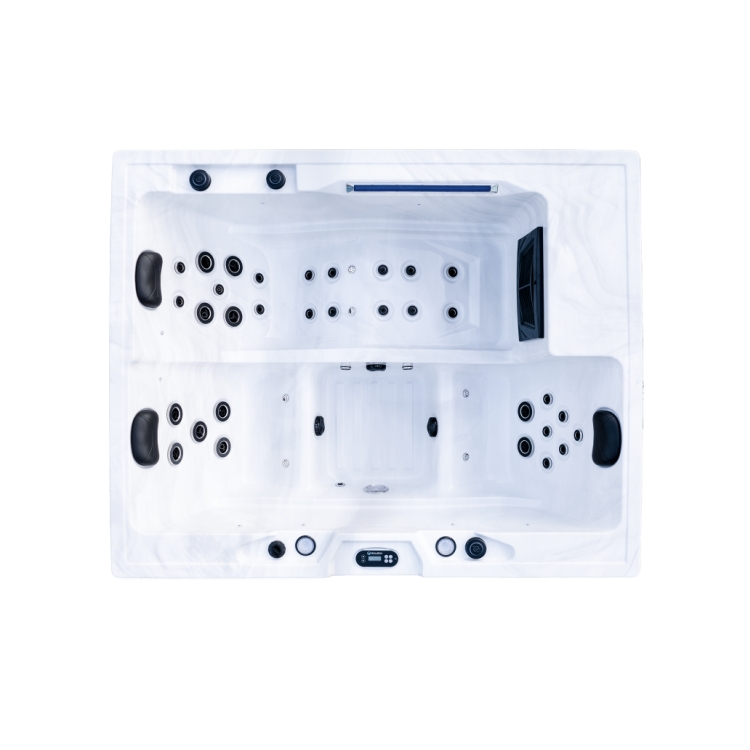
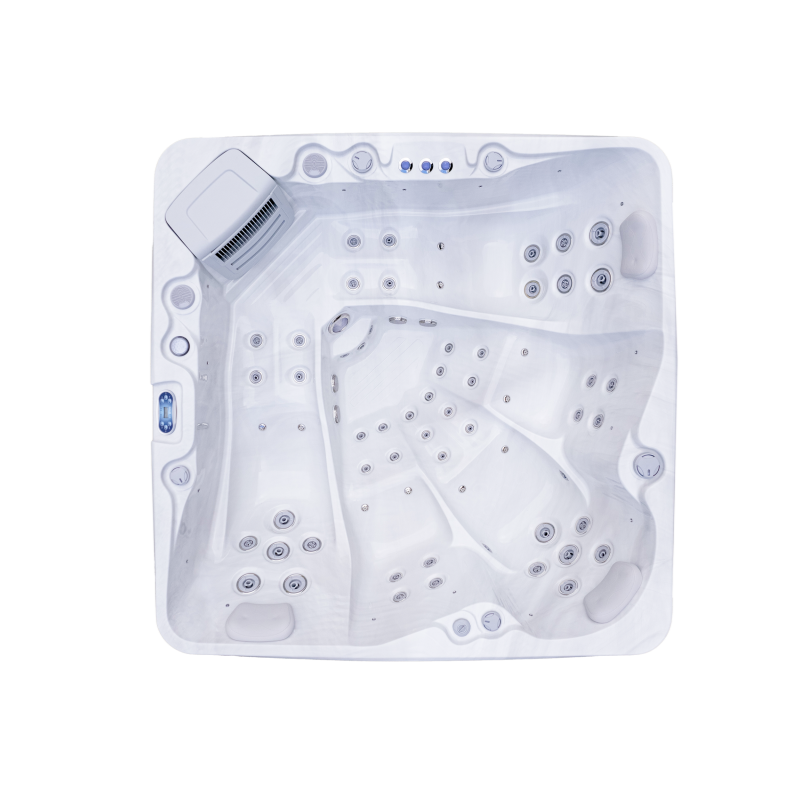
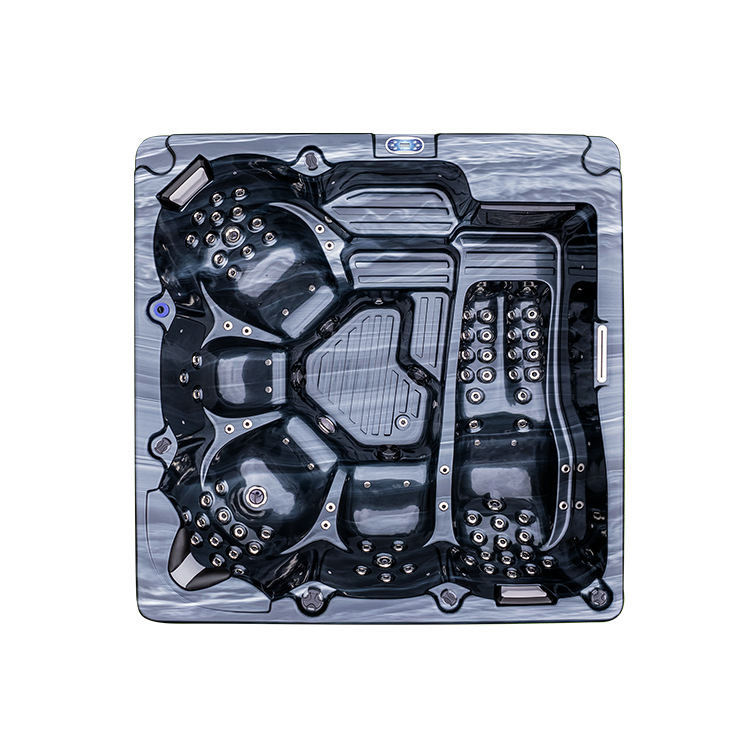
When shopping for a two-person outdoor hot tub, one of the most common questions consumers ask isn't about the number of jets, massage functions, or heating efficiency, but rather a seemingly simple question that directly impacts operating costs and the user experience: exactly how many gallons of water does it hold?
This question is significant because a spa hot tub's water capacity determines not only the initial fill time, heating duration, and energy consumption but also influences ongoing water treatment costs, maintenance frequency, and the overall experience. Unfortunately, many brands emphasize external dimensions or seating capacity in their marketing while downplaying actual water volume figures. Some manufacturers even list "theoretical volume" rather than "actual operating water capacity," leading consumers to discover—only after installation—that the water volume far exceeds expectations, resulting in higher electricity, water, and maintenance bills.
This issue is particularly relevant given the recent rapid growth of the outdoor patio lifestyle, home wellness market, and boutique hospitality sector, where two-person hot tubs have become a popular choice for both residential and commercial projects. Industry data indicates that the global market for small spa hot tubs is growing at a rate of over 8% annually (2024–2025), with two- and three-person models accounting for a significant share of new sales. While more consumers seek the private spa experience that a spa hot tub offers, there is often a lack of awareness regarding capacity, operating costs, and long-term maintenance requirements.
In reality, the water capacity of a well-designed two-person hot tub is not merely a number; it is the result of a careful balance between engineering, ergonomics, thermal efficiency, and energy management. Reputable manufacturers calculate the optimal capacity based on factors such as seat depth, jet layout, water circulation systems, and insulation structure. In contrast, some low-end products may simply increase internal space to create the impression of a "large" tub, while overlooking the resulting impact on operating costs. Specialized spa hot tub manufacturers like LOVIA® have long focused on the R&D of hot tubs and swim spas. During the design phase, they carefully balance water capacity, heating efficiency, and energy utilization. This ensures a comfortable soaking experience while avoiding the unnecessary operational burden caused by excessive water volume. This design philosophy is becoming a key trend in the modern hot tub industry.
So, exactly how many gallons of water does an outdoor two-person hot tub hold? What are the differences between various models? How does water capacity affect long-term operating costs and the user experience? This article provides a comprehensive analysis from an industry perspective.
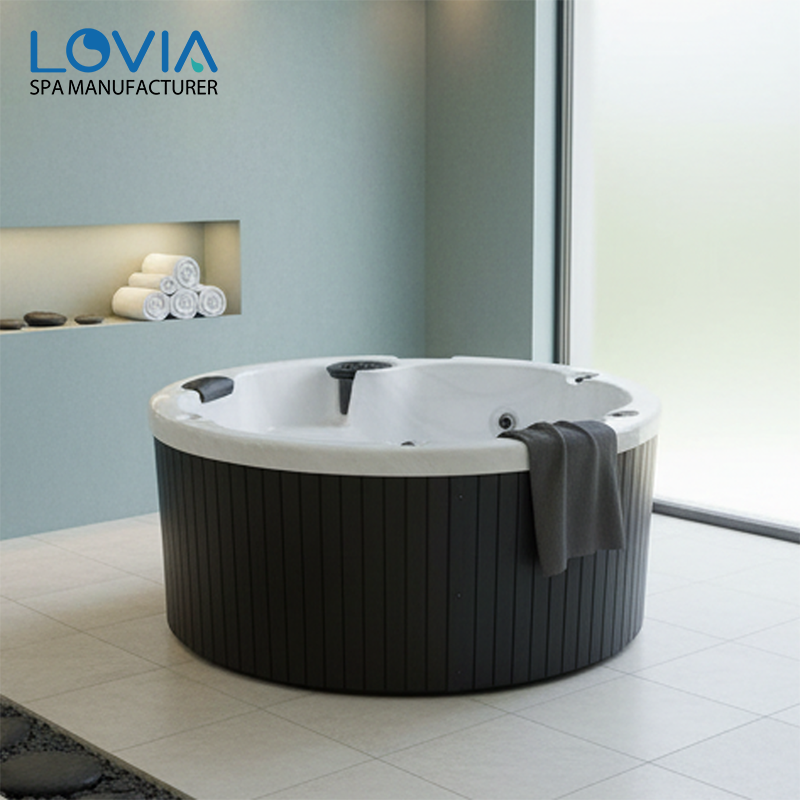
What is the standard capacity for a two-person hot tub?
Strictly speaking, there is no universal "capacity standard" for two-person spa hot tubs on the market, as different manufacturers define "two-person" differently.
Some products emphasize a compact design; others feature a luxurious layout with two lounge seats; and some, while marketed as two-person tubs, actually offer interior space comparable to four-person models.
Consequently, there is a wide range of capacities.
Based on data from mainstream products in the North American and European markets:
Type | Capacity (Gallons) | Capacity (Liters)
Compact two-person hot tub | 120–180 gallons | 450–680 liters
Standard two-person hot tub | 180–250 gallons | 680–950 liters
Luxury two-person hot tub | 250–350 gallons | 950–1,325 liters
In terms of actual market sales, the capacity of most two-person spa hot tubs falls between 200 and 300 gallons.
This converts to approximately 757 to 1,135 liters.
This is also the most common capacity range for residential backyard installations.
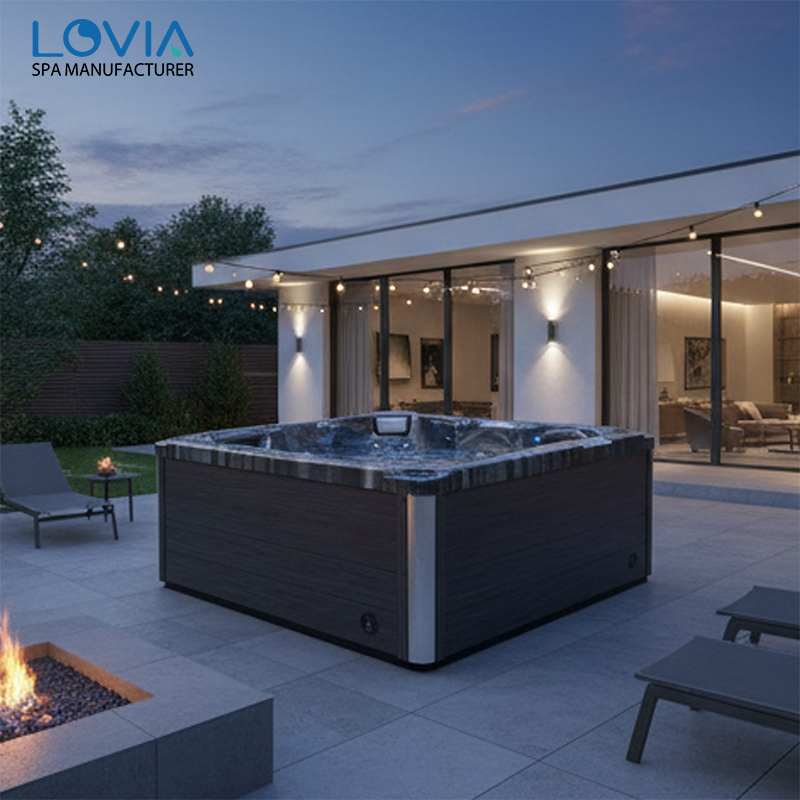
Why is there such a significant difference in capacity among two-person hot tubs?
Many consumers notice that two spa hot tubs of similar external dimensions can differ in capacity by more than 100 gallons. The primary reasons for this include the following:
1. Differences in seating design
The interior of a hot tub is not merely a vessel for holding water. The more seats there are—and the more complex their shapes—the more internal volume they occupy.
For example:
A two-person spa hot tub with dual loungers is typically designed with:
•Lumbar support zones;
•Leg extension areas;
•Shoulder-contouring sections;
These ergonomic features reduce the actual water storage space.
Consequently, even if the external dimensions are identical, the capacity may be lower than that of a standard upright seating design.
2. Differences in water level
Recommended operating water levels vary among different spa hot tubs.
Generally speaking:
•The higher the water level;
•The greater the actual capacity;
However, this also leads to:
•Increased heating costs;
•Higher water treatment costs;
•A greater risk of overflow;
Professional manufacturers usually determine the optimal water level based on jet placement rather than simply aiming for maximum capacity.
2. Differences in jet system layout
Modern spa hot tubs are equipped with numerous massage jets.
A high-end two-person hot tub might feature:
•20 jets;
•30 jets;
•40 jets;
Space must be reserved behind the jets for plumbing.
Therefore, a higher number of jets can actually reduce the usable water volume.
3. Differences in insulation design
High-quality hot tubs often utilize:
•Multi-layer foam insulation;
•Closed-cell foam insulation;
•High-density thermal barriers;
While these structures improve energy efficiency, they also occupy some internal space.
Thus, capacity is not the sole metric for evaluating the quality of a spa hot tub.
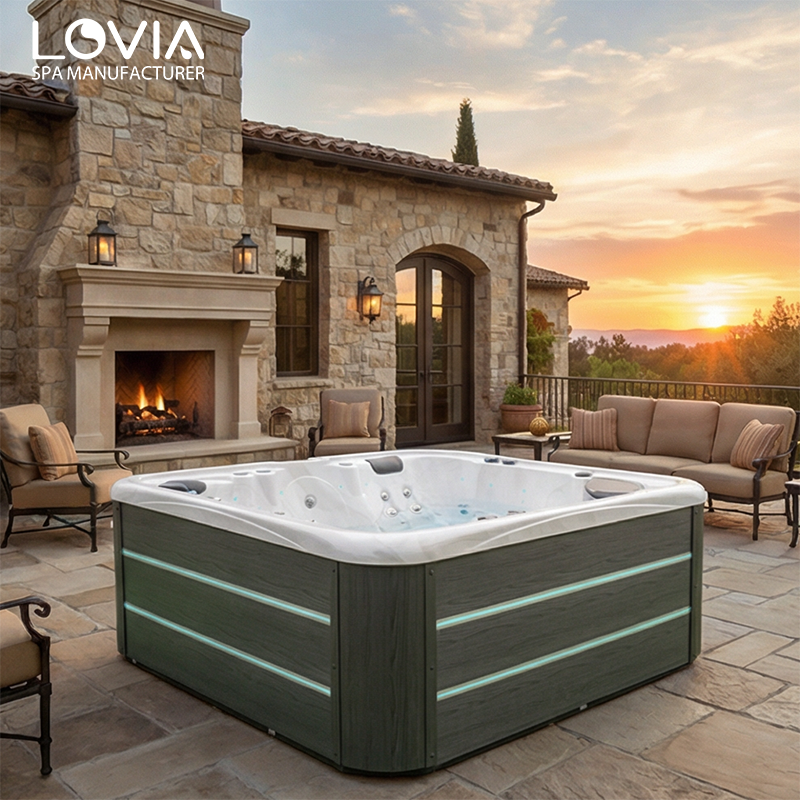
How does the capacity of a two-person hot tub affect the user experience?
Many consumers mistakenly believe that "bigger is better." In reality, this is not the case.
1. Issues with insufficient capacity
When a hot tub lacks sufficient capacity:
Once two adults enter, the following issues may occur:
•The water level rises excessively;
•Body movement is restricted;
•Massage coverage is inadequate;
Additionally, temperature fluctuations become more pronounced.
For example:
In a 150-gallon spa hot tub, the displacement caused by two adults can amount to 20–30 gallons.
The overall stability of the water volume decreases significantly.
2. Issues with excessive capacity
On the other hand: if a two-person hot tub has a capacity exceeding 400 gallons... ...this results in:
•longer heating times;
•higher electricity costs;
•increased chemical consumption;
•longer water-changing times;
...making it uneconomical for use by two people.
Therefore, the industry generally considers 200 to 300 gallons to be the most reasonable capacity range for a two-person spa hot tub.
How do you calculate the spa hot tub capacity you need?
Consumers can make a simple estimate using the following formulas:
1. Household use for two
Recommended: 200–250 gallons.
Suitable for:
•couples;
•small backyards;
•daily relaxation;
2. Frequent massage needs for two
Recommended: 250–300 gallons.
Suitable for:
•deep hydrotherapy experiences;
•longer soaking sessions;
•more jet configurations;
3. Commercial vacation rentals
Recommended: Over 300 gallons.
Suitable for:
•high turnover rates;
•users of varying body sizes;
•greater visual impact;
Capacity planning should be based on actual needs rather than simply chasing larger numbers.
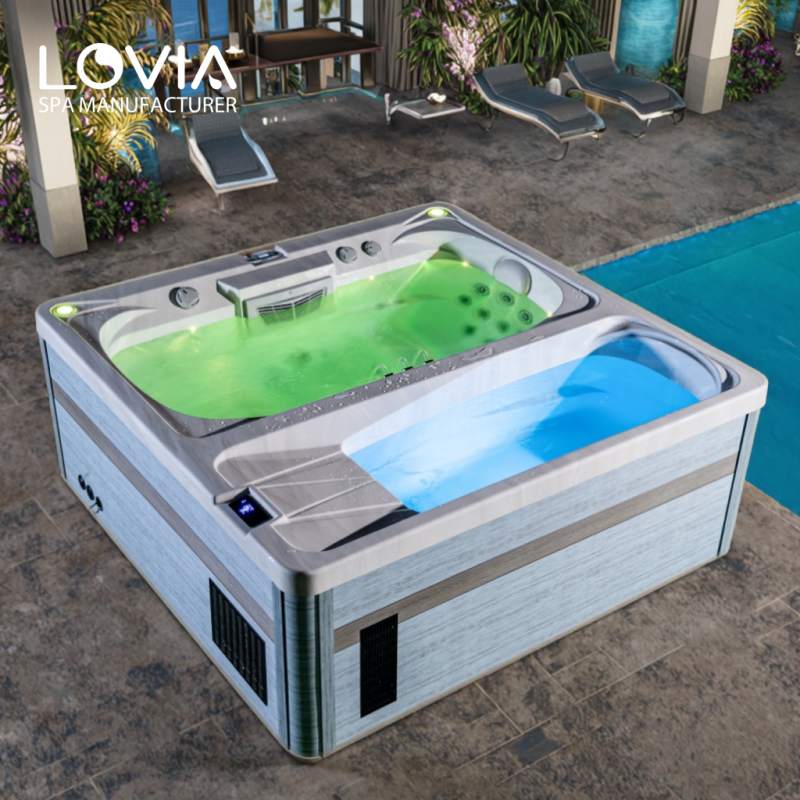
How do high-quality hot tubs achieve a "great experience with small capacity"?
A clear trend has emerged in the industry in recent years: maximizing space utilization.
For example, specialized hot tub manufacturers like LOVIA® use ergonomic simulation technology during product development to optimize seating structures, ensuring a comfortable soaking experience within a limited capacity. At the same time, optimizing plumbing layouts and insulation systems further reduces heat loss.
Users can enjoy a superior experience without increasing the volume of water stored. This approach aligns better with the modern evolution of hot tubs than simply increasing capacity.
FAQ: Common questions about two-person hot tub capacity
Q1: How many gallons of water do two-person hot tubs usually hold?
Mainstream two-person hot tubs on the market typically range from 180 to 300 gallons, with the most common range being 200 to 250 gallons.
Q2: Is a 200-gallon spa hot tub sufficient for two people?
Absolutely. For daily household use, a 200-to-250-gallon spa hot tub provides a comfortable spa experience for two.
Q3: Is a larger capacity hot tub always better?
Not necessarily. Increased capacity leads to higher costs for heating, water treatment, and maintenance. Matching the capacity to your actual needs is the best approach.
Q4: How often should the water in a two-person hot tub be changed?
It is generally recommended to replace the entire volume of water every 3 to 4 months. If usage is frequent, the interval between water changes can be shortened accordingly.
Q5: Does spa hot tub capacity affect electricity costs?
Yes. A larger capacity means a greater volume of water needs to be heated and maintained at temperature, typically resulting in higher electricity expenses.
Q6: What are the advantages of LOVIA® spa hot tubs?
Established in 1989, LOVIA® specializes in the R&D and manufacturing of spa hot tubs, swim spas, and cold plunge products. The company operates a 45,000-square-meter production facility and maintains a comprehensive quality control system; its products hold international certifications such as CE, ETL, and CB, and are exported to numerous countries and regions. In its hot tub designs, LOVIA® prioritizes ergonomics, thermal insulation, and long-term reliability, ensuring users enjoy a highly efficient and comfortable hydrotherapy experience with an optimally sized unit.
